
EXAMPLE OF MDMT CALCUALTION

MAWP
The Maximum Allowable Working Pressure (MAWP) is the highest pressure that a pressure vessel, piping system, or other pressure-containing equipment can safely withstand under normal operating conditions. It is determined during the design phase based on factors such as material properties, design configuration, and applicable standards and codes. MAWP ensures the structural integrity of the equipment and helps prevent overpressure situations that could lead to failure or safety hazards. Compliance with MAWP requirements is essential for regulatory approval and equipment safety. Regular inspection, maintenance, and documentation are crucial to ensure that equipment operates within its MAWP throughout its service life.
Importance of MAWP Calculations
Calculating the Maximum Allowable Working Pressure (MAWP) is crucial for several reasons:
1) Safety Assurance: MAWP calculation ensures that pressure vessels, piping systems, and other pressure-containing equipment operate within safe pressure limits. This helps prevent overpressure situations that could lead to equipment failure, leaks, or ruptures, safeguarding personnel and the surrounding environment.
2) Compliance with Standards: MAWP calculation ensures compliance with design codes, standards, and regulatory requirements such as the ASME Boiler and Pressure Vessel Code, European Pressure Equipment Directive (PED), and others. Adhering to these standards is essential for obtaining regulatory approvals and certifications.
3) Risk Mitigation: Accurate MAWP calculation helps identify potential risks associated with pressure equipment operation, allowing engineers to implement appropriate design measures, material selection, and operating procedures to mitigate these risks effectively.
4) Equipment Reliability: Operating equipment within its MAWP helps maintain structural integrity and reliability over its service life. Designing equipment with a sufficient margin between operating pressure and MAWP ensures long-term performance and minimizes the risk of premature failure.
5) Design Optimization: MAWP calculation facilitates the optimization of pressure vessel design by considering factors such as material strength, joint efficiency, corrosion allowances, and operating conditions. Engineers can optimize design parameters to achieve the desired level of safety and performance while minimizing material and fabrication costs.
6) Operational Efficiency: Understanding the MAWP allows operators to establish safe operating parameters, including pressure and temperature limits, to ensure equipment operates within its design limits. This promotes operational efficiency, reduces downtime, and prolongs equipment life.
7) Regulatory Compliance: Compliance with MAWP requirements is essential for regulatory approval and certification of pressure equipment. Proper MAWP calculation and documentation demonstrate due diligence in ensuring equipment safety and regulatory compliance.
Important Parameters in MAWP Calculations
Several important parameters are considered in the calculation of Maximum Allowable Working Pressure (MAWP) for pressure vessels and piping systems. These parameters ensure the equipment operates safely within its design limits. Some key parameters include:
1) Material Properties: The mechanical properties of the material used in construction, such as yield strength, tensile strength, and toughness, influence the MAWP calculation.
2) Design Configuration: Factors such as vessel geometry, thickness, shape, and structural reinforcement affect the pressure-carrying capacity of the equipment.
3) Corrosion Allowance: Corrosion allowance accounts for material loss due to corrosion over the equipment’s service life and is added to the nominal thickness to ensure adequate remaining wall thickness.
4) Joint Efficiency: Joint efficiency considers the strength of welded or bolted joints in the equipment and accounts for any reduction in strength due to fabrication processes.
5) Design Temperature: The maximum expected operating temperature of the equipment influences the MAWP calculation, as higher temperatures can reduce material strength.
6) Design Code Requirements: Compliance with applicable design codes and standards, such as ASME Boiler and Pressure Vessel Code (BPVC) or other regulatory requirements, ensures that the MAWP calculation meets industry standards and legal obligations.
7) Operating Conditions: Factors such as fluid properties, pressure fluctuations, temperature cycling, and environmental conditions must be considered to determine the MAWP under various operating scenarios.
8) Fabrication Quality: The quality of fabrication, including welding procedures, inspection techniques, and material handling practices, affects the integrity of the equipment and its ability to withstand pressure.
9) Hydrostatic Test Pressure: The hydrostatic test pressure, which is typically higher than the MAWP, is used to verify the structural integrity of the equipment during manufacturing and commissioning.
10) Service Life Considerations: The expected service life of the equipment, along with factors such as maintenance practices and inspection intervals, influences the MAWP calculation to ensure long-term reliability and safety.
Issue and Solution on MAWP Calculation
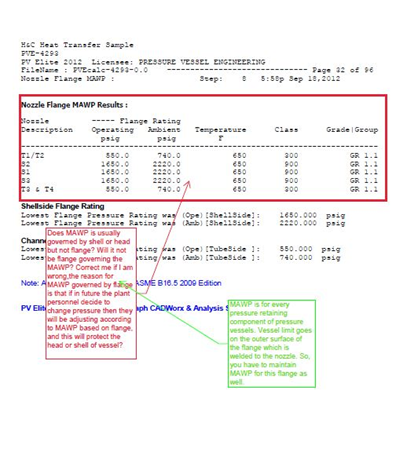
1) Issue: Does MAWP is usually governed by shell or head but not flange? Will it not be flange governing the MAWP? Correct me if I am wrong, the reason for MAWP governed by flange is that if in future the plant personnel decide to change pressure then they will be adjusting according to MAWP based on flange, and this will protect the head or shell of vessel?
Solution: MAWP is for every pressure retaining component of pressure vessels. Vessel limit goes on the outer surface of the flange which is welded to the nozzle. So, you have to maintain MAWP for this flange as well.
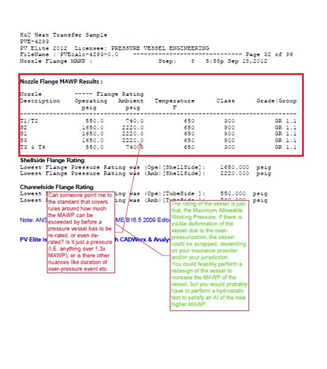
2) Issue: Can someone point me to the standard that covers rules around how much the MAWP can be exceeded by before a pressure vessel has to be re-rated, or even de-rated? Is it just a pressure (I.E. anything over 1.3x MAWP), or is there other nuances like duration of over-pressure event etc.
Solution: The rating of the vessel is just that, the Maximum Allowable Working Pressure. If there is visible deformation of the vessel due to the over-pressurization, the vessel could be scrapped, depending on your insurance provider and/or your jurisdiction.
You could feasibly perform a redesign of the vessel to increase the MAWP of the vessel, but you would probably have to perform a hydrostatic test to satisfy an AI of the new higher MAWP.
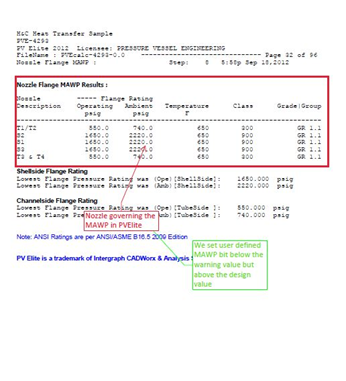
3) Issue: Nozzle governing the MAWP in PVElite
Solution: We set user defined MAWP bit below the warning value but above the design value
4) Issue: I am reading right now the API 520 that I found very interesting…
Well, in this document, they specify a difference between the MAWP and the design pressure;
It is said that “MAWP is normally greater than the design pressure”.
Is it the same rule everywhere I go or could it change from company to another one?
Solution: MAWP is “Maximum Allowable Working Pressure”. Normal operating pressure cannot exceed this number. Design pressure is the “expected” working pressure and is always less than MAWP.
For example, you have a gathering system that you expect will have 350 psig at the farthest well and you are designing your compression inlet for 100 psig–most people would use ANSI 300 flanges and valves and “standard” pipe (e.g., Sched 40 for 6-inch) for this system (MAWP around 600 psig) to make sure that normal transients don’t approach PSV set points on vessels.
5) Issue: I have a vertical suction scrubber on a nat gas compressor unit; can I run at or below MAWP? or need to operate at RDP (about 90% of MAWP)
Solution: You can perfectly run at MAWP if you do not have to deal with a Safety Relief Valve opening at that pressure, else you have to run safely under the safety valve setting which cannot be above the MAWP.
6) Issue: Can anybody tell me why compress calculate MAWP for legs support although it non-pressure retaining part?
Solution: I think if you had written to Codeware Technical Support they might have told you that the local stresses in the cylindrical shell where the leg attaches should be considered in the design of the shell. It is possible that these local stresses (analyzed by something like WRC bulletin 537) could limit the maximum pressure that the shell could sustain.
7) Issue: Insufficient or inaccurate material data, including yield strength, tensile strength, and toughness, can lead to errors in MAWP calculations.
Solution: Obtain comprehensive material data through testing and characterization, ensuring accuracy and reliability in MAWP calculations.
8) Issue: Incorrect assumptions about design parameters such as corrosion allowance, joint efficiency, or temperature limits can result in inaccurate MAWP calculations.
Solution: Ensure that design assumptions are based on sound engineering principles, validated by relevant standards and codes, and supported by empirical data and industry best practices.
9) Issue: Non-compliance with applicable design codes and standards may result in MAWP calculations that do not meet regulatory requirements.
Solution: Ensure that MAWP calculations adhere to relevant design codes and standards, such as ASME BPVC, EN standards, or other regulatory frameworks, to ensure compliance and regulatory approval.
10) Issue: Incorrect interpretation or estimation of operating conditions, such as fluid properties, temperature, pressure cycling, or environmental factors, can lead to inaccuracies in MAWP calculations.
Solution: Conduct thorough analysis and assessment of operating conditions, considering all relevant factors and potential variations, to ensure accuracy in MAWP calculations.
11) Issue: Inadequate documentation and verification of MAWP calculations may result in errors, inconsistencies, or uncertainties in the design process.
Solution: Maintain detailed documentation of MAWP calculations, including input data, assumptions, methodologies, and results, and subject them to rigorous review and verification processes by qualified engineers.
12) Issue: Neglecting to account for service life considerations, such as maintenance practices, inspection intervals, or anticipated degradation mechanisms, can lead to suboptimal MAWP calculations.
Solution: Incorporate service life considerations into MAWP calculations, ensuring that the equipment remains safe and reliable over its intended service life through appropriate design, maintenance, and inspection strategies.
Conclusion
In conclusion, accurate calculation of the Maximum Allowable Working Pressure (MAWP) is paramount for ensuring the safety, reliability, and regulatory compliance of pressure vessels and piping systems. Issues with MAWP calculations can arise due to factors such as inaccurate material data, incorrect design assumptions, inadequate code compliance, misinterpretation of operating conditions, lack of documentation, and failure to consider service life considerations. However, by implementing solutions such as obtaining comprehensive material data, adhering to relevant design codes and standards, conducting thorough analysis of operating conditions, maintaining detailed documentation, and incorporating service life considerations, engineers can mitigate these issues and ensure accurate MAWP calculations. Ultimately, accurate MAWP calculations are essential for preventing overpressure situations, maintaining equipment integrity, and safeguarding personnel and the environment.
Get detailed/ Get files/ Get customized/ Get trained by click link given here https://shreeaasaantech.com/contact-us/


