
EXAMPLE OF MDMT CALCUALTION
MDMT
The Minimum Design Metal Temperature (MDMT) is a critical factor in the design and operation of equipment subjected to low-temperature service conditions. It represents the lowest temperature at which the material of construction retains sufficient toughness to prevent brittle fracture. Engineers must ensure that the design temperature of equipment remains above the MDMT throughout its intended service life to prevent catastrophic failures. Compliance with MDMT requirements is mandated by codes and standards such as the ASME Boiler and Pressure Vessel Code and API guidelines. Calculating MDMT involves considering material properties, impact test results, and fracture toughness data. Operating conditions must also be monitored to prevent equipment from operating at temperatures below the MDMT. Overall, understanding and appropriately considering the MDMT is essential for ensuring the safety and reliability of industrial equipment operating in cold environments.
Importance of MDMT Calculations
Calculating the Minimum Design Metal Temperature (MDMT) is crucial for several reasons:
1) Structural Integrity: MDMT calculations ensure that equipment can withstand low-temperature conditions without experiencing brittle fracture, which could lead to catastrophic failure.
2) Safety: Designing equipment with consideration for MDMT helps prevent accidents, leaks, and spills that could result from material failure in low-temperature environments.
3) Regulatory Compliance: Codes and standards often require compliance with MDMT criteria to ensure equipment safety and reliability.
4) Material Selection: Understanding the MDMT allows engineers to select appropriate materials with sufficient toughness to withstand low temperatures without becoming brittle.
5) Design Considerations: MDMT influences various design parameters, including minimum design temperature, material thickness, and fabrication methods, ensuring equipment reliability in cold environments.
6) Risk Mitigation: By accounting for MDMT in design calculations, engineers can mitigate the risk of brittle fracture and ensure equipment operates safely throughout its lifecycle.
Important parameters in MDMT (Minimum Design Metal Temperature) calculations include:
Important Parameters in MDMT Calculations
1) Material Properties: Mechanical properties of the material, such as yield strength, tensile strength, impact toughness, and ductility, influence its behavior at low temperatures.
2) Fracture Toughness: The material’s resistance to crack propagation at low temperatures, determined through fracture toughness tests, is critical for assessing its suitability for low-temperature service.
3) Impact Test Results: Charpy V-notch (CVN) or Izod impact test results provide valuable data on the material’s notch toughness and transition temperature, which are key parameters in MDMT calculations.
4) Transition Temperature: The temperature at which the material undergoes a transition from ductile to brittle behavior, often determined from impact test data, is a fundamental parameter in MDMT calculations.
5) Design Temperature: The lowest expected operating temperature of the equipment dictates the MDMT requirement, ensuring that the material remains ductile and fracture-resistant under service conditions.
6) Pressure and Stress Levels: The stress levels induced by internal pressure, external loads, thermal cycling, and other factors must be considered to assess the material’s integrity at low temperatures.
7) Corrosion Effects: Exposure to corrosive environments can degrade the material’s mechanical properties, affecting its performance at low temperatures and influencing MDMT calculations.
8) Fabrication Methods: Welding, forming, and heat treatment processes can affect the material’s microstructure and mechanical properties, influencing its behavior at low temperatures.
9) Environmental Conditions: Factors such as ambient temperature variations, exposure to cryogenic fluids, and thermal gradients can impact the material’s performance at low temperatures and must be considered in MDMT calculations.
10) Code Requirements: Compliance with applicable design codes and standards, such as ASME Boiler and Pressure Vessel Code, API, and ISO guidelines, is essential for ensuring the safety and integrity of equipment in low-temperature service.
Issue and Solution on MDMT Calculation
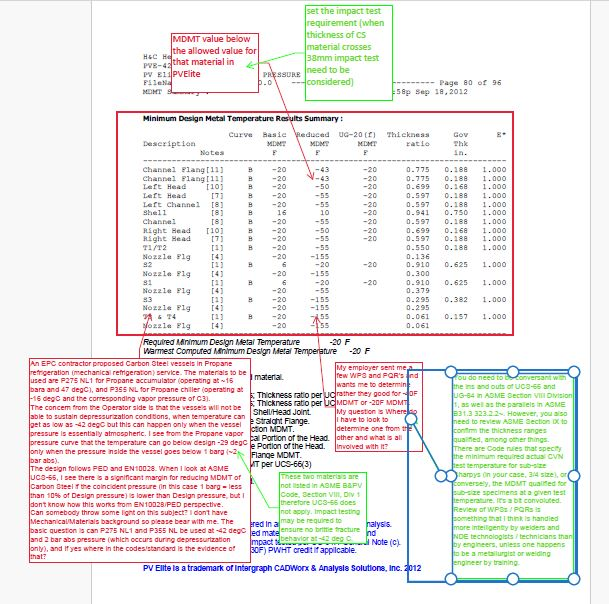
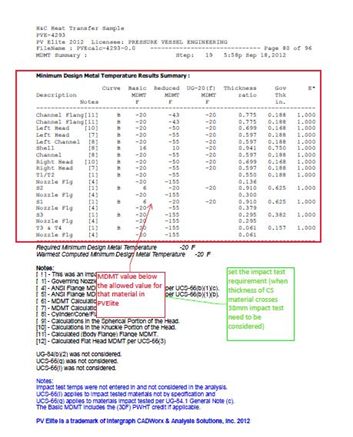
1) Issue: MDMT value below the allowed value for that material in PVElite
Solution: set the impact test requirement (when thickness of CS material crosses 38mm impact test need to be considered)
2) Issue: An EPC contractor proposed Carbon Steel vessels in Propane refrigeration (mechanical refrigeration) service. The materials to be used are P275 NL1 for Propane accumulator (operating at ~16 bara and 47 degC), and P355 NL for Propane chiller (operating at -16 degC and the corresponding vapor pressure of C3).
The concern from the Operator side is that the vessels will not be able to sustain depressurization conditions, when temperature can get as low as -42 degC but this can happen only when the vessel pressure is essentially atmospheric. I see from the Propane vapor pressure curve that the temperature can go below design -29 degC only when the pressure inside the vessel goes below 1 barg (~2 bar abs).
The design follows PED and EN10028. When I look at ASME UCS-66, I see there is a significant margin for reducing MDMT of Carbon Steel if the coincident pressure (in this case 1 barg = less than 10% of Design pressure) is lower than Design pressure, but I don’t know how this works from EN10028/PED perspective.
Can somebody throw some light on this subject? I don’t have Mechanical/Materials background so please bear with me. The basic question is can P275 NL1 and P355 NL be used at -42 degC and 2 bar abs pressure (which occurs during depressurization only), and if yes where in the codes/standard is the evidence of that?
Solution: These two materials are not listed in ASME B&PV Code, Section VIII, Div 1 therefore UCS-66 does not apply. Impact testing may be required to ensure no brittle fracture behavior at -42 deg C.
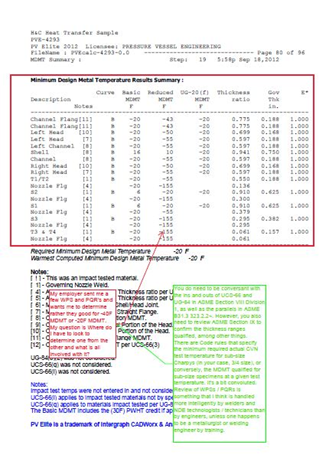
3) Issue: My employer sent me a few WPS and PQR’s and wants me to determine rather they good for -40F MDMT or -20F MDMT. My question is Where do I have to look to determine one from the other and what is all involved with it?
Solution: You do need to be conversant with the ins and outs of UCS-66 and UG-84 in ASME Section VIII Division 1, as well as the parallels in ASME B31.3 323.2.2~. However, you also need to review ASME Section IX to confirm the thickness ranges qualified, among other things.
There are Code rules that specify the minimum required actual CVN test temperature for sub-size Charpys (in your case, 3/4 size), or conversely, the MDMT qualified for sub-size specimens at a given test temperature. It’s a bit convoluted.
Review of WPSs / PQRs is something that I think is handled more intelligently by welders and NDE technologists / technicians than by engineers, unless one happens to be a metallurgist or welding engineer by training.
4) Issue: If I’m right a vessel can be at a temperature below MDMT if it’s not pressurized. Can you please help me with the definition of pressurization? I found on an old thread that it’s defined as 35% of MAWP but I can’t find this on the code.
Solution: I’d define “pressurization” as any pressure which would put the vessel into the scope of the code, i.e. any pressure above 15 psig.
This is a common misunderstanding. MDMT is the minimum temperature which the vessel will experience during actual pressurized service, in the same way that MAWT is the maximum temperature anticipated in pressurized service. You can have non-code operating cases at temperatures above MAWT or below MDMT and they do not need to be reflected on the nameplate.
For example, it is idiotic to design water-conveying piping or vessels for -40 F, using killed carbon steel etc., merely because in the installation location, ambient temperatures may drop to -40 F in winter. Those units MUST be heat traced to keep water above freezing, and if they aren’t, they’re going to rupture due to the expansion of freezing water and there’s no pressure relief device which will prevent that rupture. But a CO2 system which may auto-refrigerate in service to a very low temperature? Different matter entirely.
5) Issue: Our engineer says that Compress does not allow the user to change the MDMT above -320F on an austenitic stainless design.
Does anyone know if there is a way to input a higher MDMT?
Solution: COMPRESS provides an input for the designer to specify the “design MDMT”. COMPRESS then determines the coldest possible MDMT rating based on the material, thickness, pressure, heat treatment, etc., and ASME Code rules. Both the design and the rated MDMT values are provided in the reports.
For example, for carbon steel the procedure follows the outline in Figure UCS-66.2. Similar procedures are followed for high alloy material and UHA-51. Because the “rated” MDMT is the coldest possible per Code rules without making any changes to the materials or design there is no benefit to making the “rated” MDMT a warmer value. However, there may be changes in the ratings if you adjust the design MDMT (eg: MAWP may vary).
6) Issue: Lack of comprehensive material data, including impact test results and fracture toughness properties, can impede accurate MDMT calculations.
Solution: Obtain complete material data through thorough testing and characterization, ensuring that all relevant parameters for low-temperature behavior are available for analysis.
7) Issue: Incorrect estimation of the transition temperature (temperature at which the material transitions from ductile to brittle behavior) can lead to erroneous MDMT calculations.
Solution: Conduct rigorous impact testing, such as Charpy V-notch testing, to accurately determine the transition temperature of the material under relevant operating conditions.
8) Issue: Failure to comply with code requirements regarding MDMT calculations can result in non-compliance with industry standards and regulations.
Solution: Ensure that MDMT calculations adhere to applicable design codes and standards, such as ASME Boiler and Pressure Vessel Code, API, or ISO guidelines, to meet regulatory requirements and ensure equipment safety.
9) Issue: Difficulty in selecting appropriate materials with adequate toughness and resistance to brittle fracture at low temperatures can complicate MDMT calculations.
Solution: Consult material experts and consider a wide range of material options, including low-temperature alloys and steels with enhanced toughness properties, to identify the most suitable material for the application.
10) Issue: Thermal gradients within the equipment can affect the distribution of stresses and material behavior, impacting MDMT calculations.
Solution: Conduct thermal analysis to evaluate temperature gradients and their effects on material performance, ensuring that MDMT calculations account for realistic operating conditions.
Conclusion
In conclusion, addressing issues related to Minimum Design Metal Temperature (MDMT) calculations is essential for ensuring the safety, reliability, and regulatory compliance of equipment operating in low-temperature environments. By identifying common challenges such as insufficient material data, inaccurate transition temperature determination, code compliance issues, material selection challenges, thermal gradient considerations, environmental effects, and documentation and verification shortcomings, engineers can implement effective solutions to mitigate risks and ensure accurate MDMT calculations.
Through comprehensive material testing, adherence to applicable design codes and standards, careful consideration of thermal gradients and environmental effects, and robust documentation and verification processes, engineers can overcome MDMT-related challenges and achieve reliable design outcomes. Ultimately, accurate MDMT calculations are critical for preventing brittle fracture, ensuring equipment integrity, and maintaining safe operation in low-temperature service conditions. By prioritizing MDMT considerations and implementing appropriate solutions, engineers can enhance the overall safety and performance of industrial equipment subjected to low-temperature environments.
Get detailed/ Get files/ Get customized/ Get trained by click link given here https://shreeaasaantech.com/contact-us/


