
Issues & Solution
on
Heat Exchanger Data Sheet
EXAMPLE FOR HEAT EXCHANGER DATA SHEET

Image source: https://www.chegg.com
It is very important that heat exchanger data sheet is correct and complete. As this will be the base document for detail engineering of the heat exchanger. Any flaw in this document will lead to inefficient and wrong design of the heat exchanger.

Top Header
This includes identification details of the mechanical data sheet or specification sheet. This information includes, the logo and name of your organization. Heat exchanger description, tag number and project name are very important during erection work. As, this helps the people at site for easy and error free identification of that heat exchanger and correct installation.
Other details are document number, revision number which are important from documentation point of view. Apart from this, details of maker, checker and approver are important to trace the engineers involved in this project. Also, information for which this data sheet we are issuing is important like, it can be “issued for inquire” or “issued for comments” etc.
Operating and Mechanical Data
In this section you need to mention operating and design data for the heat exchanger. First, we provide fluid names, flow rates and its physical condition (I.e., liquid, vapor, gas) at both side of the exchanger.
Next, we mention physical properties of both side fluid at average temperature includes like, fluid density, surface tension, specific heat, latent heat, etc. Other than this we provide fouling resistances and allowable pressure drop at both side of the heat exchanger.
Operating pressure and temperature, design pressure and temperature are required to select the material allowable stress for thickness calculations. Apart from this we need to mention equivalent hydro test or pneumatic test pressure for the final equipment testing purpose.
Moreover, tube side parameters include number of tubes, number of tube pass, tube diameter, tube length, tube pitch, etc. and, for shell side baffle type, number of baffles, baffle cut, baffle spacing, tube bundle diameter, etc. information is important.
Various mechanical data comprises, corrosion allowance (around 1.6 for MS and Nil for SS), insulation thickness and type. The mechanical design is done based on above data and exchanger mechanical details are calculated. This includes details such as thickness for shell and dish ends, tube sheet thickness, body flange thickness and bolt size, tube type and thickness, etc.
Issues In This Data Sheet
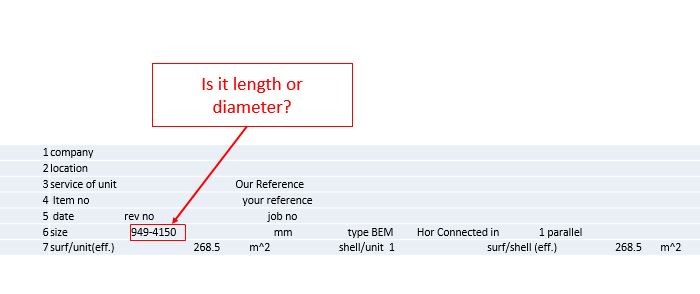
1. The size mentioned in this data sheet is not specified
Which create confusion that the dimension which are mentioned
above is It length or diameter.
Solution
Specify Units – Clearly state the units of measurement for length or diameter, whether in inches, centimeters, meters, or any other appropriate unit. This helps avoid confusion and ensures consistency in interpretation
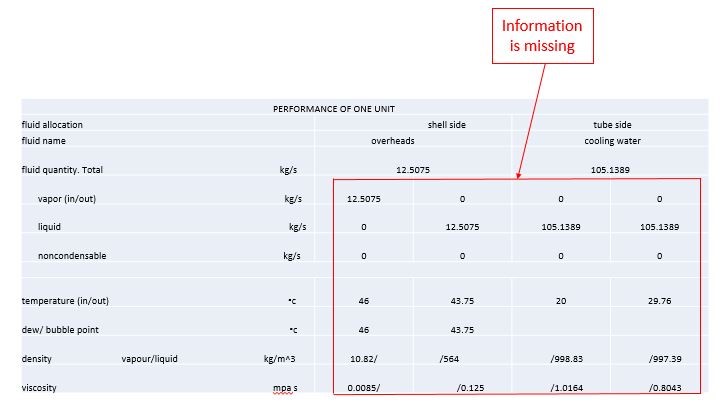
2. The quantities which are mentioned in this tables are not specified that they are inlet/outlet quantities or something else, the information about these columns are not mentioned
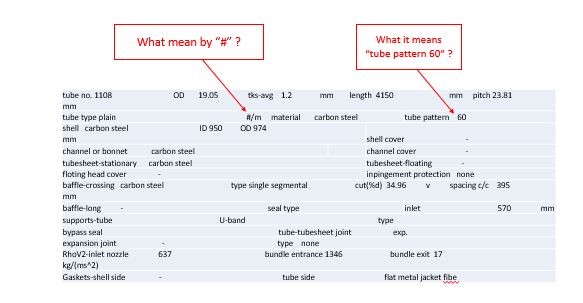
3. What mean by “#”?
the meaning of “#” is not mentioned in datasheet
4. What it means “tube pattern 60”?
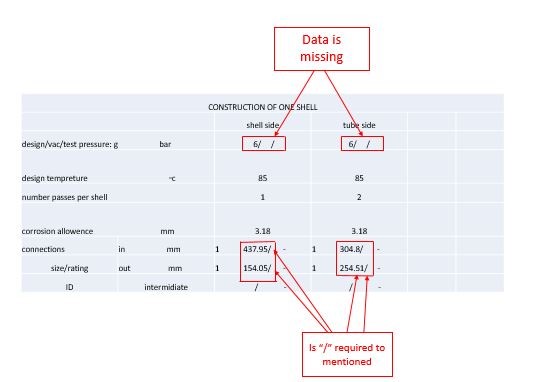
5. In this datasheet the vacuum and test pressure of the shell side and tube side are missing. The vacuum and test pressure specifications are critical for ensuring the structural integrity and safety of the heat exchanger. Without clear guidelines on the maximum vacuum and test pressure, there’s a risk of the shell being subjected to pressure beyond its design limits, leading to potential leaks, ruptures, or other structural failures.
Solution:
Document Requirements: Ensure that the vacuum and test pressure specifications are clearly documented in the heat exchanger datasheet, along with any relevant assumptions, standards references, and design calculations. This information should be readily accessible to users, operators, and regulatory authorities.
6. Is “/” required to mentioned in this table. What is “/” representing.
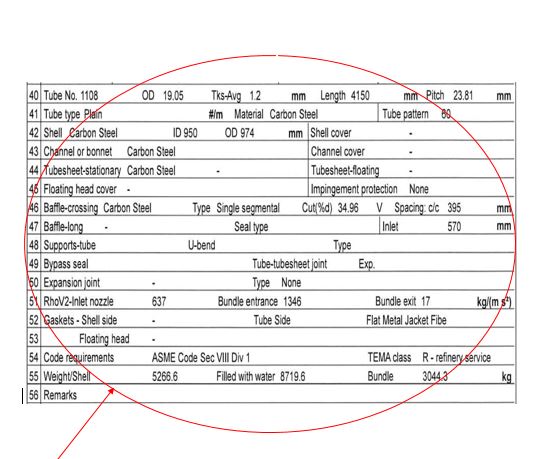
7. In this datasheet these data’s are missing 1. Partition seal, 2. Insulation, 3. Bolting, 4. Forging (Shell side) and Forging (Tube side).
Issues and solutions discussed on heat exchanger data sheet:
1. Missing Design Specifications: Missing design specifications, including material of construction, pressure ratings, temperature limits, flow rates, and heat transfer coefficients.
Solution: Ensure all necessary design specifications are clearly outlined in the datasheet, referencing applicable industry standards and codes. Provide detailed information on the intended application, operating conditions, and compatibility requirements.
2. Unclear Performance Data: Insufficient information regarding heat transfer performance, efficiency, pressure drop, fouling resistance, and thermal efficiency can lead to ambiguity and uncertainty about the heat exchanger’s capabilities.
Solution: Include comprehensive performance data obtained through laboratory, tests, simulations, or empirical correlations. Specify heat transfer coefficients, fouling factors, and pressure drop calculations for various operating conditions and fluid properties.
3. Lack of Maintenance Guidelines: Absence of maintenance guidelines, inspection procedures, cleaning recommendations, and troubleshooting tips can hinder proper care and prolong downtime.
Solution: Provide detailed maintenance schedules, inspection checklists, cleaning procedures, and troubleshooting guides tailored to the specific type and design of the heat exchanger. Include recommendations for preventive maintenance, corrosion protection, fouling mitigation, and tube bundle cleaning.
4. Missing Safety Information: Omitting safety considerations such as pressure relief valve settings, overpressure protection measures, leak detection methods, and emergency shutdown procedures poses risks to personnel and equipment.
Solution: Clearly outline safety features, alarm systems, pressure relief mechanisms, and emergency protocols to mitigate potential hazards associated with overpressure, fluids leaks, thermal expansion, and process upsets. Ensures compliance with relevant safety standards and regulations.
5.Inadequate Documentation of Test Procedures: Insufficient documentation of factory acceptance tests (FAT), hydrostatic testing, non-destructive testing (NDT), and quality assurance procedures may raise doubts about the reliability and integrity of the heat exchanger.
Solution: Document all testing procedures, acceptance criteria, inspection reports, quality control measures, and certification documentation to verify compliance with design specifications and regulatory requirements. Include traceability records for materials, welds, and manufacturing processes.
6.Lack of Technical Support Contacts: Failure to provide contact information for technical support, customer service, and warranty claims can hinder communication and resolution of issues.
Solution: Include contact details for technical support personnel, engineering experts, service centers, and warranty administrators to facilitate prompt assistance, troubleshooting, and resolution of inquiries, concerns, and warranty claims.
7.Pressure Drop: One common issue with heat exchangers is excessive pressure drop across the unit, which can lead to decreased efficiency and increased operating costs. The data sheet may provide information on the expected pressure drop at different flow rates and temperatures.
Solution: to mitigate pressure drop might include optimizing the design of the heat exchanger, selecting appropriate tube sizes, and minimizing flow restrictions.
8.Incorrect Heat Transfer Area: The heat transfer area specified on the data sheet might be incorrect, leading to inefficiencies in heat transfer.
Solution: Ensure that the heat transfer area is calculated accurately based on the design parameters and specifications. Double-check calculations and consult with heat exchanger design engineers if necessary.
9.Design Codes and Standards: Heat exchangers must comply with various design codes and standards to ensure safety and reliability. The data sheet should specify the applicable codes and standards that the heat exchanger complies with.
10.Flow Distribution: Uneven flow distribution among the heat exchanger tubes can lead to reduced efficiency and potential damage to the equipment.
Solution: The data sheet may describe features such as flow distributors, baffles, or inlet/outlet configurations designed to ensure uniform flow distribution across the heat exchanger.
By addressing these issues and implementing appropriate solutions, you can ensure that the heat exchanger operates efficiently, reliably, and safely throughout its service life.
Conclusion
If the above issues in this data sheet is solved, then this data sheet become easy to understand and become better to use.
With all relevant data included in the datasheet, users can better understand the capabilities, and limitation of the heat exchanger. This clarity reduces confusion and facilities informed decision-making during the selection, installation, and operation phases.
Complete and accurate data ensures that the heat exchanger is designed, constructed, and operated in accordance with applicable safety standards, regulations, and codes. This helps mitigate risks associated with pressure, temperature, material compatibility, and other critical factors, thereby enhancing safety and ensuring regulatory compliance.
Get detailed/ Get files/ Get customized/ Get trained by click link given here https://shreeaasaantech.com/contact-us/


