
TEMA HEAT EXCHANGER
Understanding TEMA heat exchanger: –
The Tubular Exchanger Manufactures Association, or TEMA, has developed standards that define the design, fabrication, tolerances, installation and maintenance of shell-and-tube type heat exchangers. The TEMA standard define the main configuration of exchangers and the classification for usage in the industry. This standard and the ASME code are the main governance used to design.
What are TEMA heat exchanger?
TEMA heat exchangers are shell and tube heat exchangers built to manufacturing standard laid out by the Tubular Exchanger Manufacturers Association (TEMA). TEMA regulations define the style of heat exchangers and machining and assembly tolerances.
They are divided in three major classifications, related to its duty:
- TEMA C – General service
- TEMA B – Chemical service
- TEMA R – Refinery service
As there are many variations in mechanical designs for front and rear head and shells, TEMA designation correspond to each major type of front head, shell type and rear head.
For example, in TEMA type BEM, letter “B” identifies the front head, letter “E” identifies the middle section (shell design) and letter “M” identifies the rear head.

Removable Bundle, Internal Split Ring Floating Head: type AES, BES These designs are recommended when frequent tube bundle removal is necessary. They are more favorable in thermal shock than AEW or BEW designs and they are also suitable for volatile or toxic fluids.


Advantages:
- Floating head design allows thermal expansion.
- Higher heat transfer surface area than pull-through designs (AET or BET type).
- Available to multi passes on tube side.
Limitations:
- Shell cover, split ring and floating head cover must be removed to remove the tube bundle, which results in higher maintenance costs.
Applications:
- Chemical processing applications for toxic fluids.
- Special gas after coolers and intercoolers.
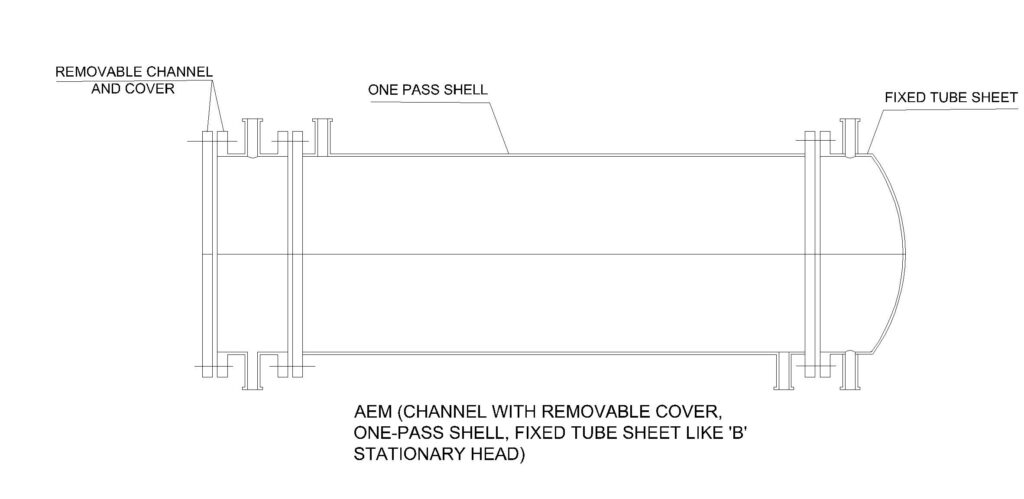
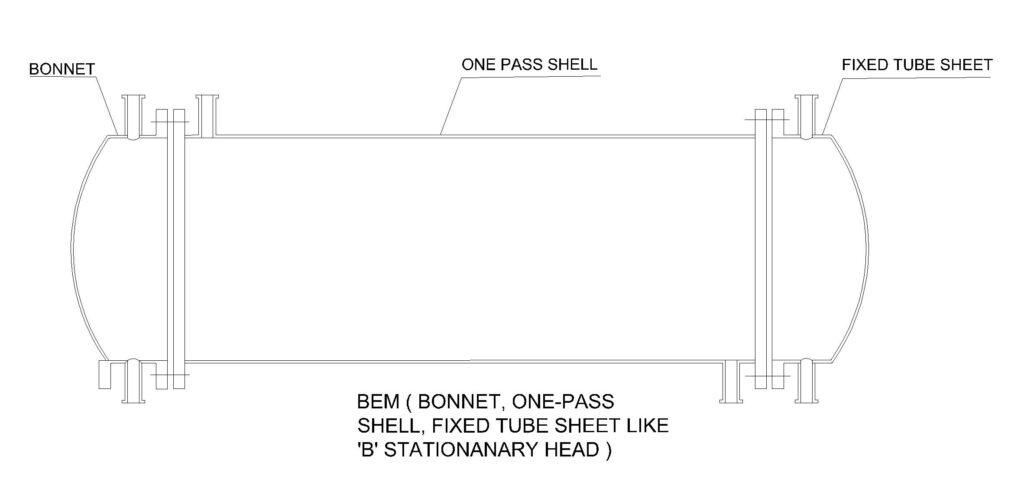
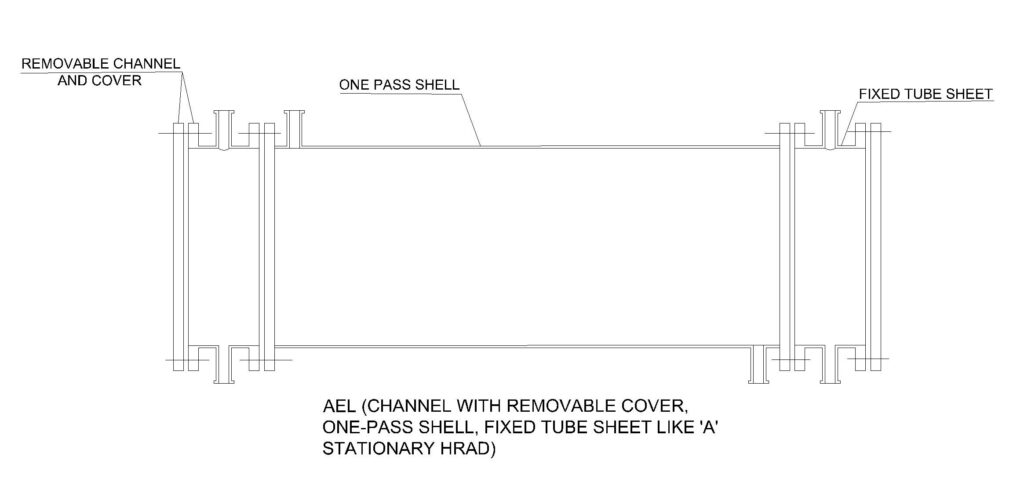
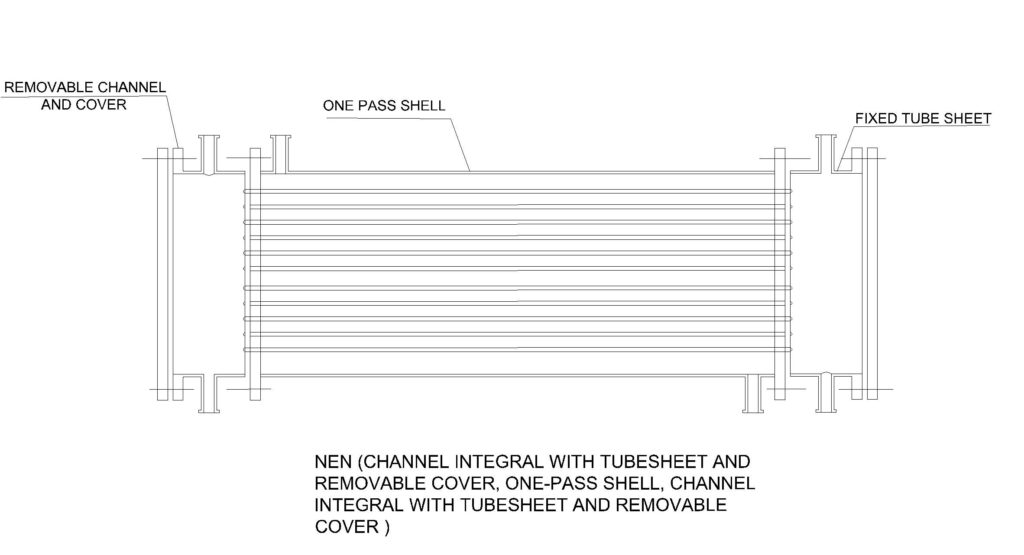
Straight Tube and Fixed Tube Sheet: type AEM, BEM, AEL, NEN
The design is the simplest design and usually more economical. The tube sheet is welded to the shell, while heads are bolted to the tube sheet.
Advantages:
- More economical than removable bundle designs.
- Capable of multiple pass designs.
Limitations:
- Chemical solution is need to clean the shell side.
- No capacity to absorb thermal expansion between the outer shell and tube bundle.
Removable Bundle, Pull Through Floating Head: type AET, BET
These types of design are the best option for applications when frequent tube bundle removal is necessary because the floating head is bolted directly to the floating tube sheet. This allows the bundle to be pulled at the same with head.
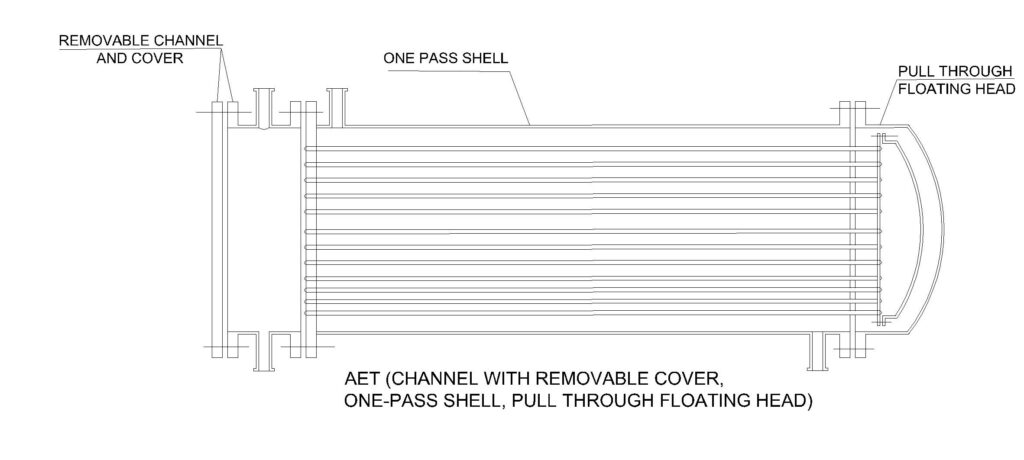
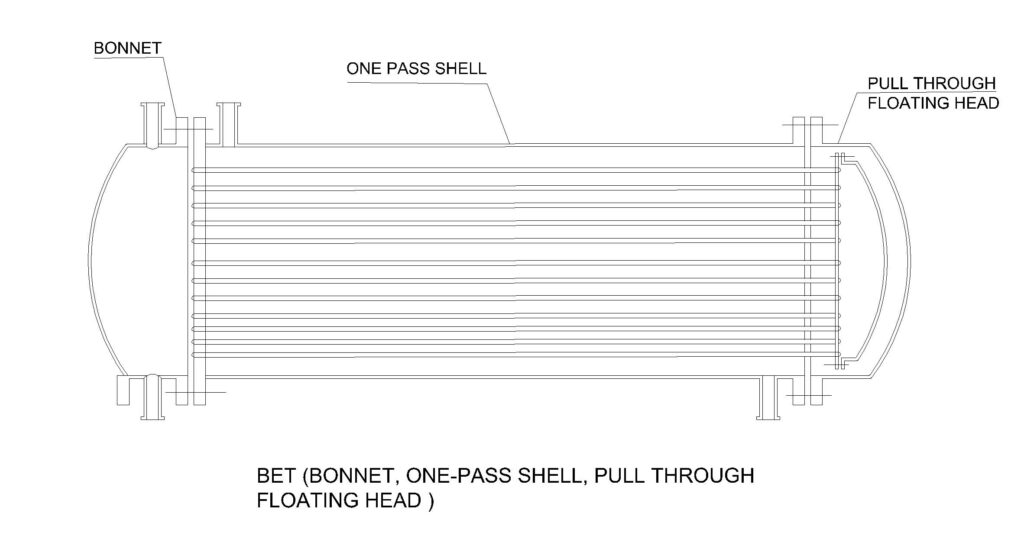
Advantages:
- Floating head design allows thermal expansion.
- Shell side can be inspected and mechanically cleaned.
- Large shell side nozzle entrance area for proper distribution over the bundle.
- Multiple tube side passes available.
- Suitable for volatile or toxic fluids.
Applications:
- General industrial applications requiring frequent cleaning.
- Chemical processing applications for toxic fluids.
- Hydrocarbon fluid condensers.
Removable Bundle, U-tube: type AEU, BEU
This design is recommended for high thermal shock applications, as each tube can be expand and contract independently and u-tube bundles are normally very economical. it is usually the best option for maximum thermal expansion applications.
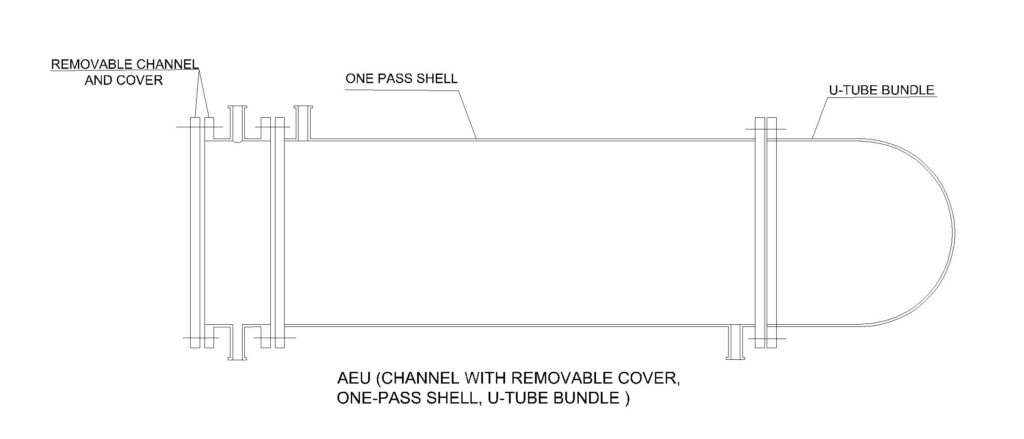

Advantages:
- The U-tube design not only allows for differential thermal expansion between the shell and tube bundle, but also each tube individually.
- Shell side can be inspected and cleaned.
- Least costly design for removable bundles.
- Multiple tube side passes are available.
- Capable of handling high thermal shock applications.
- Bundle can be removed from one end for cleaning or replacement.
Applications:
- Oil, chemical and water heating applications.
- Optimal for steam to liquid applications.
Removable bundle, externally sealed floating tube sheet – Type AEW, BEW
This design allows for the removal, inspection and cleaning of the shell circuit and shell interior. A special floating tube sheet prevents intermixing of fluids. In most cases, a straight tube design is more economical than U-tube designs.
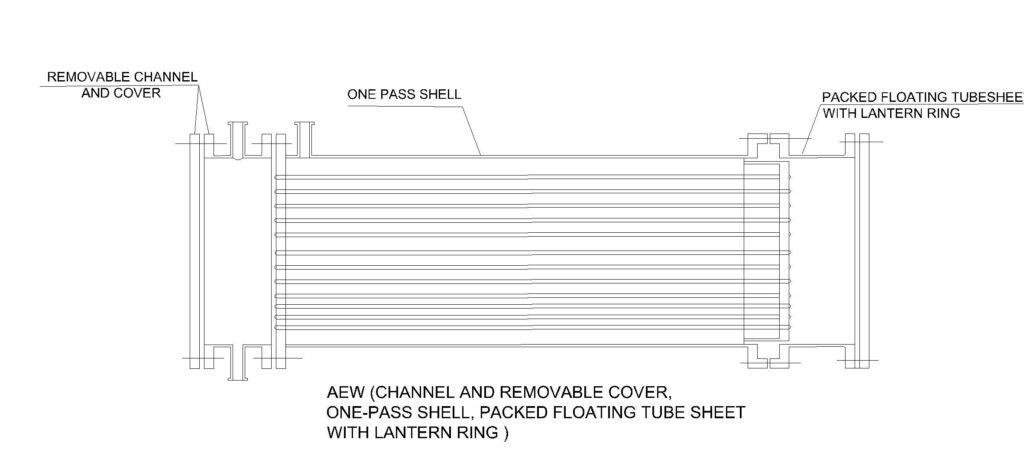
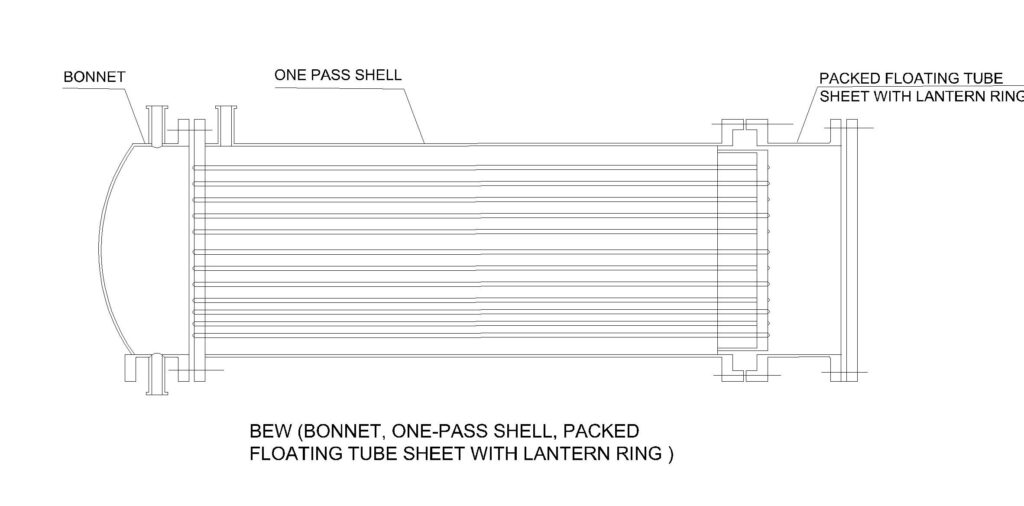
Advantages:
- Floating tube sheet allows for differential thermal expansion between the shell and the tube bundle.
- Shell circuit can be inspected and either steam- or mechanically cleaned.
- The tube bundle can be repaired or replaced without disturbing the shell pipe.
- Less costly than TEMA types BEP or BES which have an internal floating head.
- Maximum surface for a given shell diameter for removable bundle design.
- Tubes can be cleaned in AEW models without removing piping.
Limitations:
- Fluids in both the shell and tube circuits must be non-volatile and nontoxic.
- Tube side passes are limited to single or two-pass design.
- All tubes are attached to two tube sheet. Tubes cannot expand independently, so large thermal shock applications should be avoided.
- Packing materials produce limits on design pressure and temperature.
Applications:
- Intercoolers and after coolers, air inside the tubes.
- Coolers with water inside the tubes.
- Jacket water coolers or other high differential temperature duty.
- Place hot side fluid through the shell with entry nearest the front end.
Removable bundle, outside packed head – Type BEP, AEP
This design allows for the easy removal, inspection, and cleaning of the shell circuit and shell interior without removing the floating head cover. A special floating tube sheet prevents intermixing of fluids. In most cases, a straight tube removable design is costlier than U-tube designs.


Advantages
• A floating tube sheet allows for differential thermal expansion between the shell and the tube bundle.
• The shell circuit can be inspected and steam-cleaned. If the tube bundle has a square tube pitch, tubes can be mechanically cleaned by passing a brush between rows of tubes.
• The tube bundle can be repaired or replaced without disturbing shell piping.
• On AEP design, tubes can be serviced without disturbing tube-side piping.
• Less costly than TEMA type BES or BET designs.
• Only shell fluids are exposed to packing. Toxic or volatile fluids can be cooled in the tube-side circuit.
• Provides large bundle entrance area, reducing the need for entrance domes for proper fluid distribution.
Limitations
• Shell fluids limited to non-volatile, non-toxic materials.
• Packing limits the shell-side design temperature and pressure.
• All tubes are attached to two tube sheets. Tubes cannot expand independently, so large thermal shock applications should be avoided.
• Less surface per given shell and tube diameter than AEW or BEW.
Applications
• Flammable or toxic liquids in the tube circuit.
• Good for high fouling liquids in the tube circuit.

Get detailed/ Get files/ Get customized/ Get trained by click link given here- https://shreeaasaantech.com/contact-us/


Nice