
In static equipment, flanges are commonly used for connecting pipes, valves, and other components. Flanges are categorized by class (pressure-temperature rating) and size. The most common standard for flanges is ASME B16.5 in the United States. Here’s an standard flanges and their types, classes, and sizes:
1. Flange type
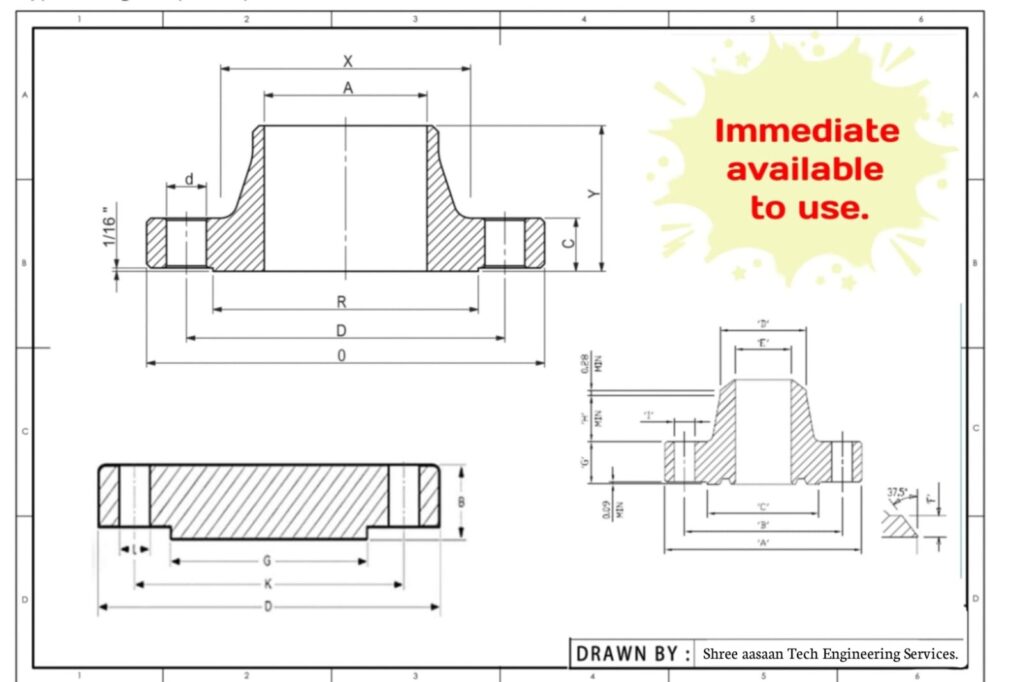
- Weld Neck Flange (WN): These are high-integrity flanges suitable for high-pressure and high-temperature applications.
- Slip-On Flange (SO): Easier to align and install, but not suitable for critical applications.
- Blind Flange (BL): Used to close the end of a pipe or a system, preventing flow.
- Socket Weld Flange (SW): Used for small-size, high-pressure applications.
- Threaded Flange (TH): Suitable for low-pressure, non-critical applications.
- Lap Joint Flange (LJ): Used in low-pressure, non-critical applications when the connection needs to be easily dismantled.
- Orifice Flange: Specifically designed for orifice metering applications.
2. Flanges classes
- Flange classes are determined by their pressure-temperature ratings. Common classes include:
- 150, 300, 600, 900, 1500, and 2500.
3. Flange Sizes:
- Flange sizes are typically given in nominal pipe sizes (NPS) or in inches. Common sizes include:
- 1/2″, 3/4″, 1″, 1-1/2″, 2″, 3″, 4″, 6″, 8″, 10″, 12″, and larger.
4. Materials:
- Flanges are available in various materials, including carbon steel, stainless steel, alloy steel, and more. The material chosen depends on the application’s requirements, such as temperature, pressure, and the fluid being handled.
Get details/ Get files/ Get customized/ Get trained by click link given here- https://shreeaasaantech.com/contact-us/


