
EXAMPLE OF FLANGE CALCULATIONS
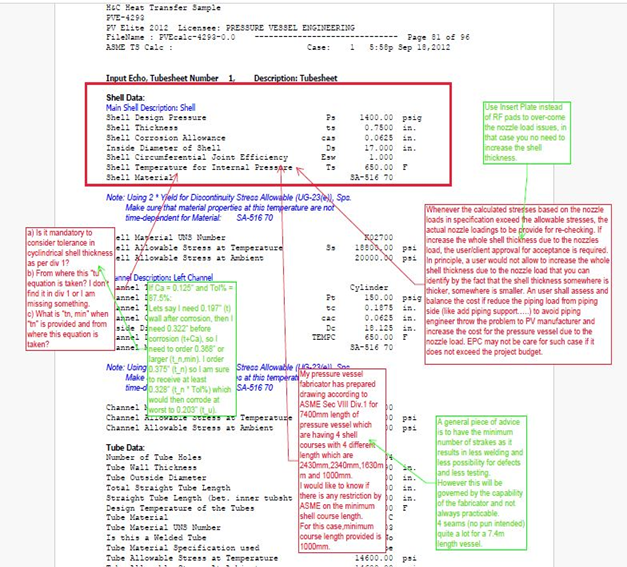
Shell Thickness
Shell thickness refers to the thickness of the cylindrical or spherical main body of a pressure vessel. In a pressure vessel, the shell is the primary structural component that contains the fluid under pressure. The shell thickness is a critical design parameter that ensures the structural integrity and safety of the vessel under operating conditions.
The shell thickness is typically determined based on various factors, including the design pressure, operating temperature, material properties, corrosion allowance, and applicable design codes and standards. Thicker shells are required for higher pressures and temperatures to withstand the internal forces and prevent deformation or rupture.
During the design process, engineers calculate the required shell thickness to meet the specified design criteria and safety margins. Finite element analysis (FEA) and stress calculations may be performed to assess the structural behavior of the vessel and validate the selected shell thickness.
factors influence the determination of shell thickness:
1) Pressure and Temperature: The design pressure and temperature of the vessel are key factors in determining the required shell thickness. Higher pressures and temperatures necessitate thicker shells to withstand the internal forces and prevent deformation or rupture.
2) Material Properties: The material properties of the shell material, such as yield strength, tensile strength, and ductility, influence the selection of the appropriate thickness. Materials with higher strength properties may allow for thinner shells, while lower-strength materials require thicker shells for adequate strength and stiffness.
3) Code Requirements: Design codes and standards, such as ASME Boiler and Pressure Vessel Code (BPVC) Section VIII, Division 1 or Division 2, specify minimum thickness requirements based on design criteria, material properties, and intended service conditions. Compliance with these code requirements is essential for ensuring regulatory compliance and safety.
4) Corrosion Allowance: Corrosion allowance is an additional thickness added to the shell to account for material loss due to corrosion over the vessel’s intended service life. The corrosion allowance helps to ensure that the shell maintains its integrity and meets design requirements even in the presence of corrosion.
5) Welding Considerations: Welding processes used to fabricate the pressure vessel, such as submerged arc welding (SAW), gas tungsten arc welding (GTAW), or shielded metal arc welding (SMAW), may influence the required shell thickness. Thicker shells may be necessary to accommodate welding procedures and achieve adequate weld penetration and strength.
6) Stress Analysis: Finite element analysis (FEA) and stress calculations are often performed to assess the structural behavior of the vessel under various loading conditions. The results of stress analysis help validate the selected shell thickness and ensure that it meets strength, stability, and fatigue requirements.
7) Operating Conditions: Factors such as cyclic loading, thermal cycling, external forces, and environmental factors may influence the selection of shell thickness to ensure the vessel’s performance and reliability throughout its service life.
Importance of shell thickness calculations:
1) Safety Assurance: The primary function of a pressure vessel is to contain pressurized fluids safely. Calculating the appropriate shell thickness ensures that the vessel can withstand the internal pressure without experiencing deformation, rupture, or other failures that could pose safety hazards to personnel and the surrounding environment.
2) Compliance with Codes and Standards: Design codes and standards, such as the ASME Boiler and Pressure Vessel Code, specify minimum thickness requirements for pressure vessel shells based on factors such as design pressure, material properties, and operating conditions. Adhering to these requirements ensures regulatory compliance and helps prevent accidents and liability issues.
3) Prevention of Overdesign or Under design: Determining the optimal shell thickness helps prevent overdesign, where the vessel is unnecessarily heavy and costly to fabricate, or under design, where the vessel may fail to meet safety requirements under operating conditions. By performing accurate calculations, engineers can strike a balance between safety, efficiency, and cost-effectiveness.
4) Structural Integrity: The shell thickness directly affects the structural integrity and stability of the pressure vessel. A properly sized shell can withstand internal pressure, external loads, and environmental factors while maintaining its shape and preventing distortion or buckling. Thicker shells provide greater resistance to deformation and are less susceptible to damage from external forces.
5) Corrosion Allowance Consideration: In addition to the required thickness for pressure containment, engineers must also account for corrosion allowance when calculating shell thickness. Corrosion allowance is an extra thickness added to the shell to compensate for material loss due to corrosion over the vessel’s service life. By including corrosion allowance in the calculations, engineers ensure that the vessel maintains its integrity and meets design requirements over time.
6) Optimization of Material Usage: Accurate shell thickness calculations help optimize material usage by ensuring that the vessel is neither under designed nor overdesigned. Using the right amount of material not only reduces fabrication costs but also minimizes the weight and footprint of the vessel, making it more manageable and cost-effective to install and operate.
Overall, the calculation of shell thickness is essential for the safe and efficient design, fabrication, and operation of pressure vessels. By considering factors such as design codes, operating conditions, material properties, and corrosion protection, engineers can ensure that pressure vessels meet safety standards, regulatory requirements, and industry best practices.
Issues and Solutions on Shell Thickness Calculation
the calculation of shell thickness is essential for the safe and efficient design, fabrication, and operation of pressure vessels.
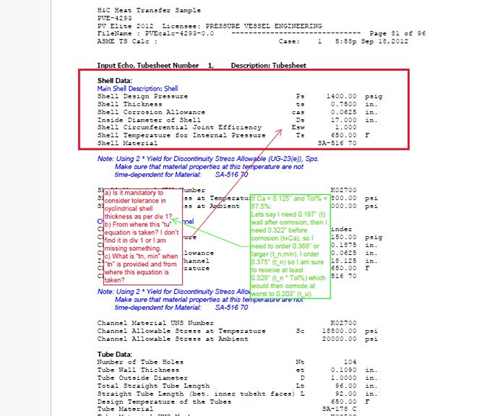
1) Issues: a) Is it mandatory to consider tolerance in cylindrical shell thickness as per div 1?
b) From where this “tu” equation is taken? I don’t find it in div 1 or I am missing something.
c) What is “tn, min” when “tn” is provided and from where this equation is taken?
Solution: If Ca = 0.125″ and Tol% = 87.5%:
Let’s say I need 0.197″ (t) wall after corrosion, then I need 0.322″ before corrosion (t+Ca), so I need to order 0.368″ or larger (t_n, min). I order 0.375″ (t_n) so I am sure to receive at least 0.328″ (t_n * Tol%) which would then corrode at worst to 0.203″ (t_u).
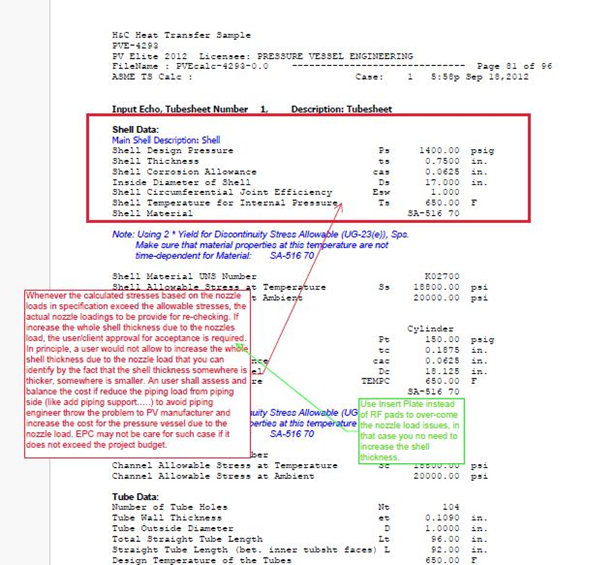
2) Issues: Whenever the calculated stresses based on the nozzle loads in specification exceed the allowable stresses, the actual nozzle loadings to be provide for re-checking. If increase the whole shell thickness due to the nozzles load, the user/client approval for acceptance is required.
In principle, a user would not allow to increase the whole shell thickness due to the nozzle load that you can identify by the fact that the shell thickness somewhere is thicker, somewhere is smaller. A user shall assess and balance the cost if reduce the piping load from piping side (like add piping support….) to avoid piping engineer throw the problem to PV manufacturer and increase the cost for the pressure vessel due to the nozzle load. EPC may not be care for such case if it does not exceed the project budget.
Solution: Use Insert Plate instead of RF pads to over-come the nozzle load issues, in that case you no need to increase the shell thickness.
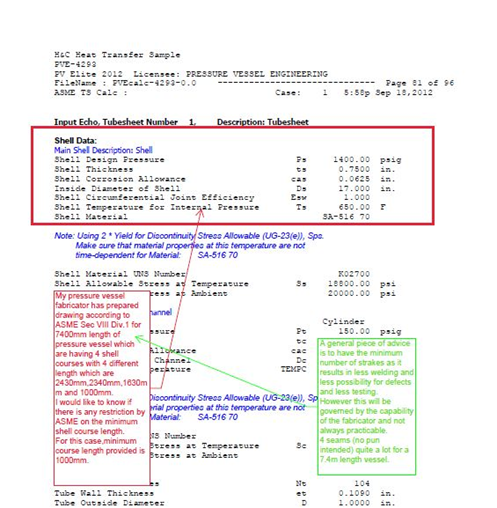
3) Issues: My pressure vessel fabricator has prepared drawing according to ASME Sec VIII Div.1 for 7400mm length of pressure vessel which are having 4 shell courses with 4 different lengths which are 2430mm,2340mm,1630mm and 1000mm.
I would like to know if there is any restriction by ASME on the minimum shell course length.
For this case, minimum course length provided is 1000mm.
Solution: A general piece of advice is to have the minimum number of strakes as it results in less welding and less possibility for defects and less testing.
However, this will be governed by the capability of the fabricator and not always practicable.
4 seams (no pun intended) quite a lot for a 7.4m length vessel.
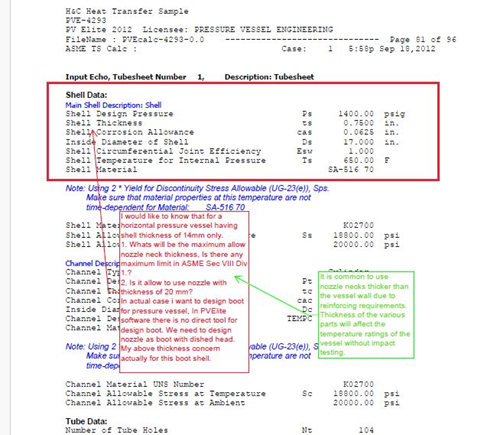
4) Issue: I would like to know that for a horizontal pressure vessel having shell thickness of 14mm only.
1. What’s will be the maximum allow nozzle neck thickness, Is there any maximum limit in ASME Sec VIII Div. 1.?
2. Is it allow to use nozzle with thickness of 20 mm?
In actual case I want to design boot for pressure vessel, In PVElite software there is no direct tool for design boot. We need to design nozzle as boot with dished head. My above thickness concern actually for this boot shell.
Solution: It is common to use nozzle necks thicker than the vessel wall due to reinforcing requirements.
Thickness of the various parts will affect the temperature ratings of the vessel without impact testing.
5) Issue: Errors in input data, such as incorrect pressure, temperature, material properties, or corrosion allowance, can lead to inaccurate shell thickness calculations.
Solution: Verify all input data against design specifications, material test reports, and operating conditions. Ensure that all parameters are accurately documented and consistently applied in the calculations.
6) Issue: Pressure vessels may be subjected to a combination of internal pressure, external loads, thermal stresses, and other loading conditions, making it challenging to determine the appropriate shell thickness.
Solution: Conduct a comprehensive analysis of all anticipated loading conditions using appropriate engineering methods, such as finite element analysis (FEA) or hand calculations. Consider the effects of transient loads, seismic events, wind loads, and thermal gradients to ensure robust design.
7) Issue: Design codes and standards provide guidelines for determining minimum shell thickness, but their interpretation and application can be complex, especially when multiple code editions or jurisdictional requirements apply.
Solution: Engage experienced engineers familiar with relevant design codes, such as ASME BPVC Section VIII, Division 1 or Division 2, to interpret code requirements accurately. Stay updated on code revisions, interpretations, and industry best practices.
8) Issue: Corrosion can degrade the thickness of the vessel shell over time, affecting its structural integrity. Failure to account for corrosion allowance in the design calculations can lead to premature failure.
Solution: Incorporate corrosion allowance into the shell thickness calculations based on corrosion rate data, anticipated service life, and environmental conditions. Consider the use of corrosion-resistant materials or protective coatings to mitigate corrosion effects.
Conclusion
In conclusion, shell thickness calculations are crucial for the safe and reliable design of pressure vessels. However, various challenges and issues may arise during the calculation process, requiring careful consideration and effective solutions. By addressing issues such as inaccurate input data, complex loading conditions, interpretation of design codes, corrosion considerations, material selection, and verification, engineers can ensure the integrity and performance of pressure vessel designs.
A thorough understanding of design codes and standards, along with attention to detail in input data verification and analysis, is essential for accurate shell thickness calculations. Collaboration among experienced engineers, materials specialists, and code experts is valuable in resolving complex issues and ensuring compliance with regulatory requirements.
Additionally, incorporating corrosion allowance, conducting comprehensive loading analyses, and implementing rigorous verification and review processes contribute to the robustness and reliability of pressure vessel designs.
Ultimately, by overcoming challenges and implementing effective solutions, engineers can achieve optimized shell thickness designs that meet safety standards, regulatory requirements, and industry best practices, ensuring the long-term integrity and performance of pressure vessels in various applications.
By addressing these common issues with shell thickness calculations and implementing appropriate solutions, engineers can ensure the integrity, safety, and reliability of pressure vessel designs. Collaboration, attention to detail, and adherence to best practices are essential for achieving successful outcomes in pressure vessel engineering.
Get detailed/ Get files/ Get customized/ Get trained by click link given here https://shreeaasaantech.com/contact-us/


