
EXAMPLE OF SADDLE CALCULATIONS
Saddle
A saddle is a structural support used to stabilize and distribute the weight of cylindrical vessels, such as pressure vessels or tanks, onto a supporting surface. It helps evenly distribute the vessel’s weight, minimizing stress concentrations and ensuring stability during operation, transportation, and storage. Saddles come in various types, including skirted saddles with extended legs or skirts for additional support, non-skirted saddles for basic support, and pipe saddles designed for supporting piping systems. When designing saddles, factors such as load-bearing capacity, material selection, stability, support, alignment, attachment methods, installation, and maintenance must be considered to ensure structural integrity and reliability. Proper design, installation, and maintenance of saddles are crucial for ensuring the safe and reliable operation of cylindrical vessels in industrial applications.
Importance of Saddle Calculations:
Saddle calculations are essential for ensuring the structural integrity and stability of cylindrical vessels, such as pressure vessels or tanks, during operation, transportation, and storage. Here’s why saddle calculations are important:
1) Structural Integrity: Saddle calculations determine the load-bearing capacity and structural adequacy of the saddles to support the weight of the vessel and its contents. Proper calculations ensure that the saddles can withstand applied loads, including static loads from the vessel’s weight, dynamic loads from fluid movement, and external forces such as wind or seismic loads.
2) Stability and Support: Saddles provide critical support and stability to cylindrical vessels, preventing tipping, sliding, or tilting during operation or transportation. Calculations ensure that the saddles are properly designed and positioned to distribute the vessel’s weight evenly onto the supporting surface, minimizing stress concentrations and deformation.
3) Safety Assurance: Properly designed saddles help mitigate the risk of structural failure, collapse, or loss of containment, which could result in catastrophic accidents, environmental damage, or injury to personnel. Accurate calculations ensure that the saddles meet safety standards and regulatory requirements, reducing the likelihood of accidents or incidents.
4) Optimized Design: Saddle calculations allow engineers to optimize the design of saddles for efficiency, reliability, and cost-effectiveness. Factors such as material selection, saddle geometry, weld size, and attachment methods can be evaluated to minimize weight, material usage, and fabrication costs while meeting performance requirements.
5) Compliance with Standards: Saddle calculations ensure compliance with relevant design codes, standards, and regulatory requirements, such as the ASME Boiler and Pressure Vessel Code. Adhering to these standards helps guarantee that the saddles meet industry best practices, quality standards, and safety regulations.
6) Risk Mitigation: Thorough saddle calculations help identify potential design flaws, structural weaknesses, or loading issues that could compromise the performance or safety of the vessel. Addressing these issues during the design phase minimizes the risk of costly repairs, unplanned downtime, or safety incidents during operation.
7) Documentation and Verification: Proper documentation of saddle calculations provides a record of the design rationale, assumptions, methodologies, and results. This documentation facilitates design verification, supports regulatory compliance, and enables effective troubleshooting and maintenance throughout the equipment’s lifecycle.
Important Parameters in Saddle Calculations:
Several important parameters must be considered in saddle calculations to ensure the structural integrity and stability of cylindrical vessels. These parameters include:
1) Vessel Weight: The weight of the cylindrical vessel, including the weight of the vessel itself and any additional weight from its contents, such as fluids or equipment.
2) Applied Loads: External loads acting on the vessel, including static loads (such as the weight of the contents and equipment), dynamic loads (such as fluid movement or wind loads), and environmental loads (such as seismic loads or snow loads).
3) Saddle Material: The material used to fabricate the saddle, which should be selected based on factors such as strength, corrosion resistance, and compatibility with the vessel material.
4) Saddle Geometry: The shape and dimensions of the saddle, including the width, length, height, and curvature, which determine the contact area and distribution of load between the vessel and the supporting surface.
5) Load Distribution: The method by which the saddle distributes the weight of the vessel onto the supporting surface, ensuring that the load is evenly distributed to prevent stress concentrations and deformation.
6) Attachment Method: How the saddle is attached to the vessel, whether through welding, bolting, or other means, and ensuring that the attachment method provides sufficient strength and stability.
7) Stress Analysis: Performing stress analysis to determine the stresses and strains in the saddle under various loading conditions, ensuring that the saddle can withstand applied loads without exceeding allowable stress limits.
8) Safety Factors: Applying appropriate safety factors to account for uncertainties in material properties, loading conditions, and design assumptions, ensuring a margin of safety against failure.
9) Code Compliance: Ensuring that saddle calculations comply with relevant design codes, standards, and regulatory requirements, such as the ASME Boiler and Pressure Vessel Code or applicable industry standards.
10) Fatigue Analysis: Evaluating the potential for fatigue failure in the saddle under cyclic loading conditions, such as thermal cycling or dynamic loads, and designing the saddle to withstand fatigue-induced stresses over its expected service life.
Issue and Solutions on Saddle Calculations
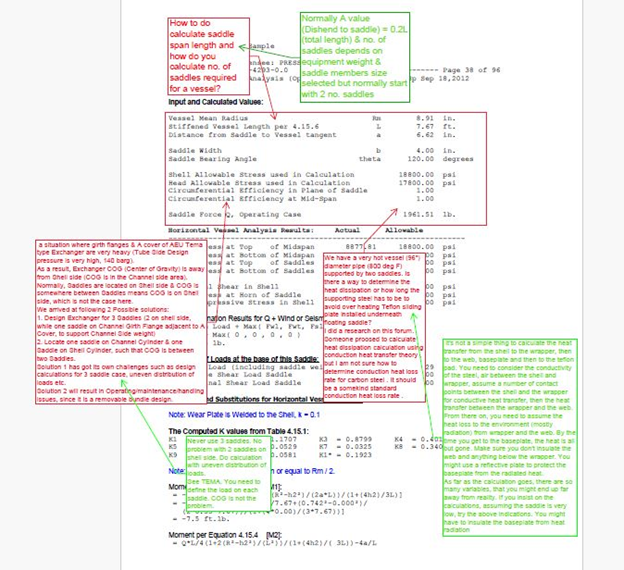
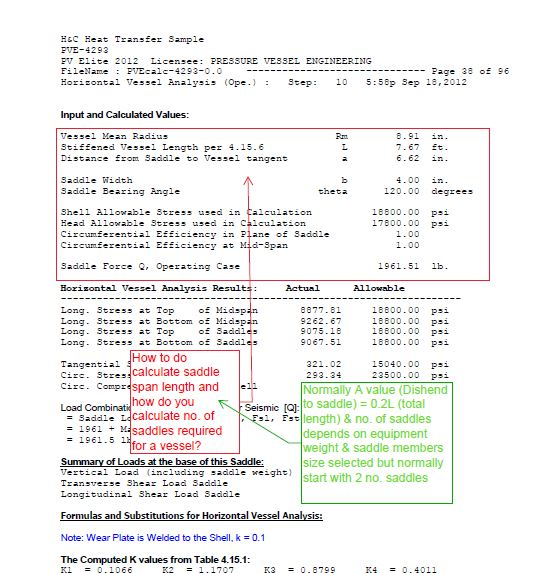
1) Issue: How to do calculate saddle span length and how do you calculate no. of saddles required for a vessel?
Solution: Normally A value (Dish end to saddle) = 0.2L (total length) & no. of saddles depends on equipment weight & saddle members size selected but normally start with 2 no. saddles
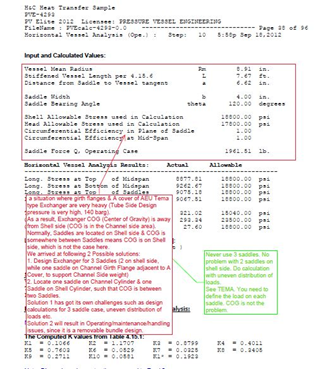
2) Issue: a situation where girth flanges & A cover of AEU Tema type Exchanger are very heavy (Tube Side Design pressure is very high, 140 barg).
As a result, Exchanger COG (Center of Gravity) is away from Shell side (COG is in the Channel side area).
Normally, Saddles are located on Shell side & COG is somewhere between Saddles means COG is on Shell side, which is not the case here.
We arrived at following 2 Possible solutions:
1. Design Exchanger for 3 Saddles (2 on shell side, while one saddle on Channel Girth Flange adjacent to A Cover, to support Channel Side weight)
2. Locate one saddle on Channel Cylinder & one Saddle on Shell Cylinder, such that COG is between two Saddles.
Solution 1 has got its own challenges such as design calculations for 3 saddle case, uneven distribution of loads etc.
Solution 2 will result in Operating/maintenance/handling issues, since it is a removable bundle design.
Solution: Never use 3 saddles. No problem with 2 saddles on shell side. Do calculation with uneven distribution of loads.
See TEMA. You need to define the load on each saddle. COG is not the problem.
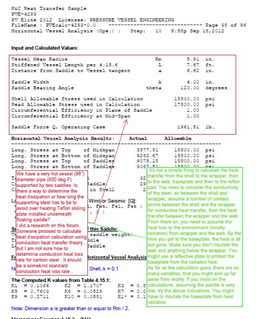
3) Issue: We have a very hot vessel (96”) diameter pipe (800 deg. F) supported by two saddles. Is there a way to determine the heat dissipation or how long the supporting steel has to be to avoid over heating Teflon sliding plate installed underneath floating saddle?
I did a research on this forum. Someone proposed to calculate heat dissipation calculation using conduction heat transfer theory, but I am not sure how to determine conduction heat loss rate for carbon steel. It should be some kind standard conduction heat loss rate.
Solution: it’s not a simple thing to calculate the heat transfer from the shell to the wrapper, then to the web, baseplate and then to the Teflon pad. You need to consider the conductivity of the steel, air between the shell and wrapper, assume a number of contact points between the shell and the wrapper for conductive heat transfer, then the heat transfers between the wrapper and the web. From there on, you need to assume the heat loss to the environment (mostly radiation) from wrapper and the web. By the time you get to the baseplate, the heat is all but gone. Make sure you don’t insulate the web and anything below the wrapper. You might use a reflective plate to protect the baseplate from the radiated heat.
As far as the calculation goes, there are so many variables, that you might end up far away from reality. If you insist on the calculations, assuming the saddle is very low, try the above indications. You might have to insulate the baseplate from heat radiation
4) Issue: If the saddle fails to distribute the vessel’s weight evenly onto the supporting surface, it can lead to localized stress concentrations and deformation.
Solution: Review the saddle geometry and adjust its dimensions or curvature to ensure proper load distribution and minimize stress concentrations.
5) Issue: Incorrect material selection for the saddle can result in insufficient strength, corrosion susceptibility, or compatibility issues with the vessel material.
Solution: Evaluate the mechanical properties, corrosion resistance, and compatibility of the saddle material with the vessel material, and select a suitable material that meets design requirements.
6) Issue: Improper attachment methods, such as inadequate welding or bolting techniques, can compromise the integrity and stability of the saddle.
Solution: Ensure that proper welding procedures, weld quality, and bolt tightening procedures are followed to securely attach the saddle to the vessel and supporting surface.
7) Issue: High stress concentrations in the saddle can lead to premature failure or fatigue cracking.
Solution: Perform stress analysis to identify areas of high stress concentration and modify the saddle design or geometry to reduce stress concentrations and improve structural integrity.
8) Issue: Insufficient safety factors applied in saddle calculations may result in under-designed saddles that are prone to failure under load.
Solution: Apply appropriate safety factors to account for uncertainties in material properties, loading conditions, and design assumptions, ensuring a margin of safety against failure.
Conclusion
In conclusion, addressing issues with saddle calculations is essential for ensuring the structural integrity, stability, and safety of cylindrical vessels in industrial applications. By identifying common issues such as inadequate load distribution, material selection errors, attachment method deficiencies, stress concentrations, insufficient safety factors, and non-compliance with codes, engineers can implement effective solutions to mitigate risks and ensure reliable saddle design.
The solutions involve adjustments to saddle geometry, proper material selection, adherence to welding and bolting standards, stress analysis to identify and mitigate stress concentrations, application of appropriate safety factors, compliance with relevant codes and standards, and thorough documentation and review processes. By following these steps, engineers can design saddles that distribute loads evenly, withstand applied forces, and meet safety requirements.
Regular review and validation of saddle calculations, along with adherence to industry best practices, are crucial for ensuring the continued integrity and reliability of saddles supporting cylindrical vessels. Ultimately, a well-designed and properly executed saddle calculation process contributes to the safe operation and longevity of industrial equipment.
Get detailed/ Get files/ Get customized/ Get trained by click link given here https://shreeaasaantech.com/contact-us/


