
EXAMPLE OF Hydrotest Calculation
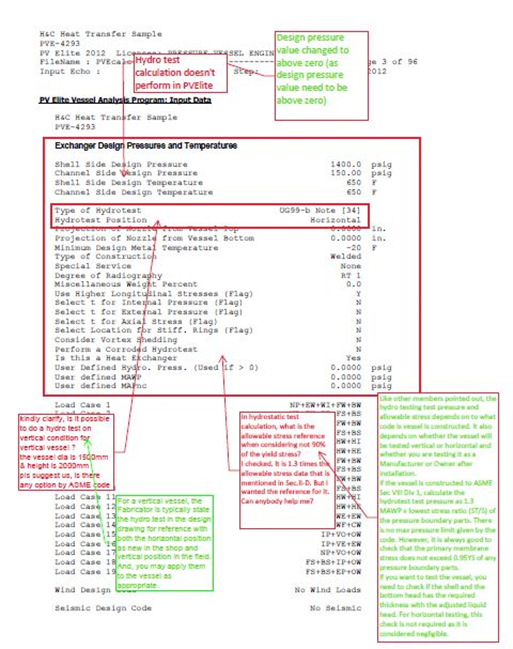
Hydrotest
A hydrostatic test, commonly known as a hydrotest, is a crucial procedure in the testing and validation of pressure equipment’s integrity. It involves pressurizing the equipment with a liquid, typically water, to a level above its operating pressure. This test verifies the equipment’s ability to withstand pressure and ensures it is free from leaks or defects. Hydrotests are conducted according to industry standards and regulatory requirements, such as those outlined in codes like the ASME Boiler and Pressure Vessel Code or API standards. The test procedure includes filling the equipment with water, pressurizing it gradually to the specified test pressure, holding the pressure for a set duration, and then inspecting for any leaks or deformations. Safety precautions are paramount during hydrotests due to the high-pressure conditions involved, and personnel must follow strict protocols to mitigate risks. Documentation of the test procedure, results, and any observations or deviations is essential for regulatory compliance and quality assurance purposes. Overall, hydrostatic testing is a critical quality control measure that helps ensure the safe and reliable operation of pressure equipment in various industries.
Importance of Hydrotest Calculations
The hydrostatic test calculation is important for several reasons:
1) Safety Assurance: By accurately calculating the test pressure, engineers ensure that the pressure vessel or system is subjected to sufficient pressure to verify its integrity without exceeding its design limits. This helps prevent potential failures or leaks during service, enhancing safety for personnel and the surrounding environment.
2) Compliance with Standards: Regulatory bodies and industry standards often mandate specific test pressures and durations for hydrostatic testing. Calculating the test pressure according to these requirements ensures compliance with relevant codes and standards, such as ASME BPVC, API standards, or jurisdictional regulations.
3) Verification of Design: The hydrotest calculation confirms that the pressure vessel or system can withstand the specified test pressure without experiencing excessive deformation or leakage. This provides validation of the vessel’s design and construction, as well as the integrity of its components.
4) Risk Mitigation: Accurate hydrotest calculations help identify potential weaknesses or defects in the pressure vessel or system before it is put into service. By subjecting the equipment to rigorous testing, engineers can detect and address any issues early, reducing the risk of failure and ensuring long-term reliability.
5) Quality Assurance: Hydrostatic testing is a critical quality control measure in the manufacturing and fabrication of pressure equipment. Calculating the appropriate test pressure ensures that all components meet the required standards and specifications, providing assurance of product quality and performance.
6) Documentation: Hydrotest calculations, along with test pressure, duration, and results, are documented as part of the equipment’s inspection and testing records. This documentation serves as proof of compliance with regulatory requirements and provides a record of the equipment’s testing history for future reference.
Important Factors in Hydrotest Calculation
Several important factors are considered in hydrotest calculations to ensure the test is conducted safely and effectively:
1) Design Pressure: The hydrotest pressure is typically a percentage (e.g., 150%) of the design pressure of the vessel or system. Calculating the test pressure based on the design pressure ensures that the equipment is subjected to sufficient pressure to verify its integrity without exceeding its design limits.
2) Material Properties: The mechanical properties of the materials used in the construction of the vessel or system, such as yield strength and ultimate tensile strength, influence the hydrotest calculation. These properties are essential for determining the allowable stress levels and safety margins during the test.
3) Corrosion Allowance: The hydrotest calculation may incorporate a corrosion allowance, which is additional thickness added to the vessel or system to account for material loss due to corrosion over time. Including a corrosion allowance helps ensure that the equipment remains structurally sound throughout its intended service life.
4) Temperature: The temperature of the test fluid (usually water) during the hydrotest affects the density and viscosity of the fluid, which, in turn, impact the test pressure calculation. Changes in temperature can also affect the material properties of the vessel or system, necessitating adjustments in the hydrotest calculation.
5) Safety Factors: Safety factors are applied to the hydrotest calculation to provide a margin of safety and account for uncertainties in material properties, manufacturing processes, and test conditions. These safety factors help ensure that the equipment is subjected to a conservative test pressure that exceeds its expected operating conditions.
6) Duration of Test: The duration of the hydrotest, typically specified in standards or regulations, affects the overall stress applied to the vessel or system. Longer test durations allow for more thorough inspection and detection of leaks or deformations, but must be balanced with practical considerations such as project schedule and cost.
7) Regulatory Requirements: Hydrotest calculations must comply with applicable codes, standards, and regulatory requirements, such as those outlined in ASME BPVC, API standards, or jurisdictional regulations. These requirements dictate the test pressure, duration, acceptance criteria, and documentation needed for the hydrotest.
8) Documentation: Proper documentation of the hydrotest calculation, including the test pressure, duration, results, and any deviations from expected values, is essential for regulatory compliance and quality assurance purposes. Detailed records ensure that the test was conducted correctly and provide a reference for future inspections and maintenance.
Issue and Solution on Hydrotest Calculation
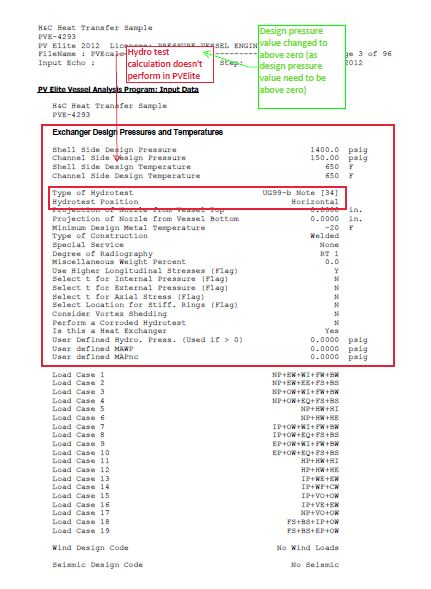
1) Issue: Hydro test calculation doesn’t perform in PVElite
Solution: Design pressure value changed to above zero (as design pressure value need to be above zero)
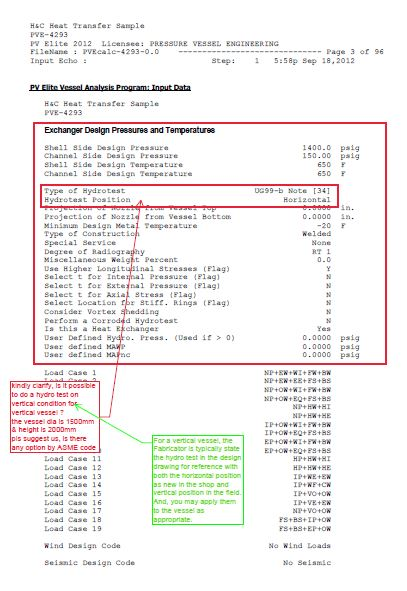
2) Issue: kindly clarify, is it possible to do a hydro test on vertical condition for vertical vessel?
the vessel dia is 1500mm & height is 2000mm
pls suggest us, is there any option by ASME code
Solution: For a vertical vessel, the Fabricator is typically state the hydro test in the design drawing for reference with both the horizontal position as new in the shop and vertical position in the field. And, you may apply them to the vessel as appropriate.
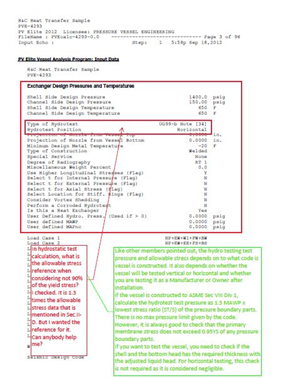
3) Issue: In hydrostatic test calculation, what is the allowable stress reference when considering not 90% of the yield stress?
I checked. It is 1.3 times the allowable stress data that is mentioned in Sec.II-D. But I wanted the reference for it.
Can anybody help me?
Solution: Like other members pointed out, the hydro testing test pressure and allowable stress depends on to what code is vessel is constructed. It also depends on whether the vessel will be tested vertical or horizontal and whether you are testing it as a Manufacturer or Owner after installation.
if the vessel is constructed to ASME Sec VIII Div 1, calculate the hydrotest test pressure as 1.3 MAWP x lowest stress ratio (ST/S) of the pressure boundary parts. There is no max pressure limit given by the code. However, it is always good to check that the primary membrane stress does not exceed 0.95YS of any pressure boundary parts.
If you want to test the vessel, you need to check if the shell and the bottom head has the required thickness with the adjusted liquid head. For horizontal testing, this check is not required as it is considered negligible.
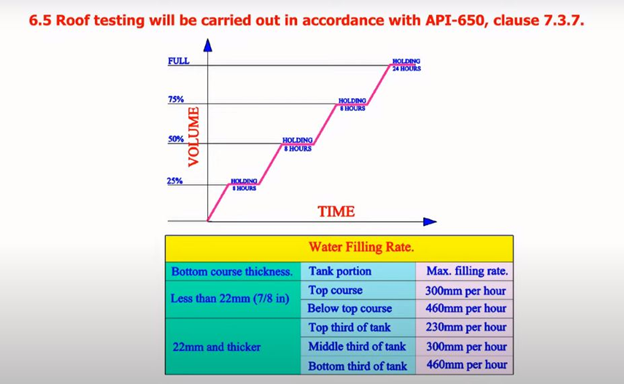
4) Issue: I have a concern with regards to the required volumetric flow rate for filling a tank to be hydro tested. Is there such thing? I was thinking i need this data for sizing the required pipes and pumps to be used by using Q=AV. Though API 650 gave Water Filling Rate at Section 7.3.6.5, these aren’t volumetric flow rate right? We may consider these as velocity, isn’t it?
Any idea for the pipe and pump sizing?
Solution: You simply need to convert this to volume based on the square area of your tank. The filling rate can be converted to a height (volume) per minute or second. Don’t exceed this flowrate (gpm or l/sec or m3/hr).
Your sizing of the pumps is based on flow and the pressure / head you need to pump from wherever your water supply is to the tank plus the max height of the tank.
5) Issue: Using an incorrect design pressure for the hydrotest calculation can result in under- or over-pressurization of the vessel or system during the test.
Solution: Verify the design pressure from the engineering specifications or design documents. Ensure that the hydrotest pressure is calculated as a percentage (e.g., 150%) of the design pressure, as per industry standards.
6) Issue: Incorrect material properties, such as yield strength or ultimate tensile strength, can lead to inaccuracies in stress calculations and, consequently, in the hydrotest pressure determination.
Solution: Use accurate and up-to-date material properties for the materials used in the construction of the vessel or system. Refer to material certificates or conduct material testing if necessary to obtain reliable data.
7) Issue: Failure to account for corrosion allowance in the hydrotest calculation can result in inadequate thickness and compromise the integrity of the vessel or system.
Solution: Incorporate a corrosion allowance into the hydrotest calculation to ensure that the equipment can withstand corrosion over its intended service life. Follow industry standards or project specifications for determining the appropriate corrosion allowance.
8) Issue: Changes in temperature can affect the density and viscosity of the test fluid, as well as the material properties of the vessel or system, leading to inaccuracies in the hydrotest calculation.
Solution: Consider the effects of temperature on the hydrotest calculation by adjusting the properties of the test fluid and materials accordingly. Use appropriate temperature correction factors or conduct thermal analysis if necessary.
9) Issue: Incorrect application of safety factors may result in either overly conservative or insufficient test pressures, compromising the effectiveness of the hydrotest.
Solution: Use appropriate safety factors based on engineering judgment, industry best practices, and regulatory requirements. Ensure that the selected safety factors provide an adequate margin of safety while considering all relevant factors.
10) Issue: Failure to comply with applicable codes, standards, and regulatory requirements in the hydrotest calculation can lead to non-compliance and potential safety or legal issues.
Solution: Ensure that the hydrotest calculation adheres to all relevant codes, standards, and regulations, such as ASME BPVC, API standards, or jurisdictional requirements. Consult with qualified professionals or regulatory authorities as needed to ensure compliance.
Conclusion
In conclusion, hydrotest calculations are crucial for verifying the structural integrity and safety of pressure vessels and systems. Addressing common issues such as incorrect design pressure, inaccurate material properties, missing corrosion allowance, temperature effects, safety factor selection, and regulatory compliance is essential to ensure accurate and reliable results.
By applying appropriate solutions, such as verifying design parameters, using accurate material data, incorporating corrosion allowances, considering temperature effects, selecting suitable safety factors, and complying with relevant codes and standards, engineers can perform hydrotest calculations effectively.
A thorough understanding of the principles and requirements of hydrostatic testing, along with attention to detail in the calculation process, is essential for ensuring the success of the hydrotest and the integrity of the pressure equipment. Additionally, proper documentation of the hydrotest calculation, results, and any deviations from expected values is crucial for regulatory compliance and quality assurance purposes.
Ultimately, by addressing issues and implementing solutions in hydrotest calculations, engineers can conduct tests confidently, mitigate risks, and ensure the safe and reliable operation of pressure vessels and systems in various industrial applications.
Get detailed/ Get files/ Get customized/ Get trained by click link given here https://shreeaasaantech.com/contact-us/


