
EXAMPLE OF EXTERNAL PRESSURE CALCULATION OF HEAT EXCHANGER
External Pressure of Heat Exchanger
External pressure in a heat exchanger refers to the force exerted on its outer surface by the surrounding environment. It acts in opposition to the internal pressure exerted by the fluid inside the exchanger. External pressure can be caused by atmospheric conditions, vacuum environments, or surrounding fluids or gases. Design considerations for external pressure include material selection, wall thickness, reinforcement, and support arrangements to ensure structural integrity and prevent collapse or deformation. Compliance with industry standards and codes, such as ASME BPVC and TEMA, is essential to ensure safety and reliability. Testing and inspection methods, such as hydrostatic testing and visual examination, help verify the exchanger’s ability to withstand external pressure. Mitigation strategies may involve using thicker materials, adding reinforcement features, or modifying the design to distribute pressure loads effectively. Regulatory compliance is crucial for ensuring adherence to safety guidelines and obtaining necessary approvals for heat exchanger operation. Overall, addressing external pressure concerns is vital for the performance and integrity of heat exchangers in various operating conditions.
Importance of External Pressure Calculation of Heat Exchanger
The calculation of external pressure in a heat exchanger is of paramount importance due to several reasons:
1) Structural Integrity: External pressure can exert significant forces on the heat exchanger’s shell or tubes. Proper calculation ensures that the heat exchanger is designed to withstand these forces without deformation, collapse, or failure.
2) Safety: Heat exchangers operate in diverse environments, including vacuum conditions or areas with high external pressures. Accurate calculation helps ensure that the exchanger can safely operate under these conditions without compromising personnel safety or environmental integrity.
3) Prevention of Buckling: Excessive external pressure can lead to buckling of the heat exchanger’s components, resulting in catastrophic failure. By calculating external pressure, engineers can design the exchanger to resist buckling and maintain structural stability.
4) Compliance with Standards: Industry standards and codes, such as ASME BPVC and TEMA, mandate the calculation of external pressure to ensure compliance with safety and quality requirements. Adhering to these standards is essential for regulatory compliance and industry best practices.
5) Optimization of Design: Accurate calculation allows engineers to optimize the design of the heat exchanger for maximum efficiency and performance while ensuring it can withstand external pressure conditions. This optimization may involve material selection, wall thickness optimization, or the addition of reinforcement features.
6) Risk Mitigation: By assessing external pressure during the design phase, engineers can identify potential risks and implement appropriate mitigation measures. This proactive approach helps minimize the likelihood of equipment failure and associated operational disruptions or safety hazards.
7) Reliability: A properly designed heat exchanger that accounts for external pressure conditions is more reliable and less prone to unexpected failures or downtime. This reliability is critical for industries where uninterrupted operation is essential, such as petrochemical, power generation, and manufacturing.
8) Quality Assurance: The calculation of external pressure is an integral part of the design and engineering process, providing assurance that the heat exchanger meets stringent quality standards and performance requirements. It demonstrates a commitment to quality and reliability throughout the equipment’s lifecycle.
Important Factors in External Pressure Calculation of Heat Exchanger
Several important factors must be considered in the calculation of external pressure for a heat exchanger:
1) Design Pressure: The design pressure specifies the maximum allowable pressure that the heat exchanger can withstand under normal operating conditions. It serves as a reference point for calculating external pressure and ensuring that the exchanger can safely operate within its design limits.
2) Operating Environment: The external pressure calculation should account for the specific operating environment in which the heat exchanger will be installed. Factors such as atmospheric pressure, surrounding fluid properties, and temperature variations play a significant role in determining the external pressure acting on the exchanger.
3) Material Properties: The material properties of the heat exchanger components, including the shell, tubes, and any structural reinforcements, influence their ability to withstand external pressure. Factors such as yield strength, ultimate tensile strength, and modulus of elasticity are critical for accurate stress analysis and determining the exchanger’s resistance to external pressure.
4) Geometry and Configuration: The geometric characteristics of the heat exchanger, such as its shape, size, and arrangement of components, affect how external pressure is distributed across its surface. Factors such as shell diameter, wall thickness, tube arrangement, and support structures must be considered in the calculation to ensure an accurate assessment of external pressure effects.
5) Corrosion Allowance: Corrosion allowance is an additional thickness applied to the heat exchanger components to account for potential corrosion over its service life. It is essential to include corrosion allowance in the external pressure calculation to ensure that the exchanger maintains structural integrity and safety margins over time.
6) Reinforcements and Supports: Structural reinforcements, such as stiffening rings, ribs, or support structures, are often incorporated into the heat exchanger design to enhance its resistance to external pressure. These reinforcements should be properly accounted for in the calculation to ensure they effectively mitigate external pressure effects and prevent deformation or failure.
Issue and Solution on External Pressure Calculation of Heat Exchanger
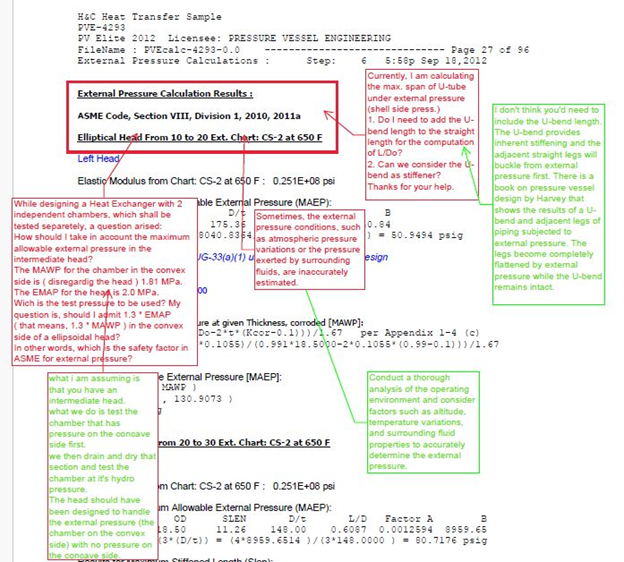
1) Issue: Currently, I am calculating the max. span of U-tube under external pressure (shell side press.)
1. Do I need to add the U-bend length to the straight length for the computation of L/Do?
2. Can we consider the U-bend as stiffener?
Solution: I don’t think you’d need to include the U-bend length. The U-bend provides inherent stiffening and the adjacent straight legs will buckle from external pressure first. There is a book on pressure vessel design by Harvey that shows the results of a U-bend and adjacent legs of piping subjected to external pressure. The legs become completely flattened by external pressure while the U-bend remains intact.
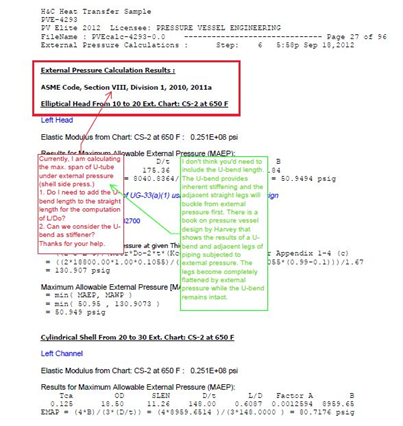
2) Issue: While designing a Heat Exchanger with 2 independent chambers, which shall be tested separately, a question arised:
How should I take in account the maximum allowable external pressure in the intermediate head?
The MAWP for the chamber in the convex side is (disregarding the head) 1.81 MPa.
The EMAP for the head is 2.0 MPa.
Which is the test pressure to be used? My question is, should I admit 1.3 * EMAP (that means, 1.3 * MAWP) in the convex side of an ellipsoidal head?
In other words, which is the safety factor in ASME for external pressure?
Solution: what I am assuming is that you have an intermediate head.
what we do is test the chamber that has pressure on the concave side first.
we then drain and dry that section and test the chamber at its hydro pressure.
The head should have been designed to handle the external pressure (the chamber on the convex side) with no pressure on the concave side.
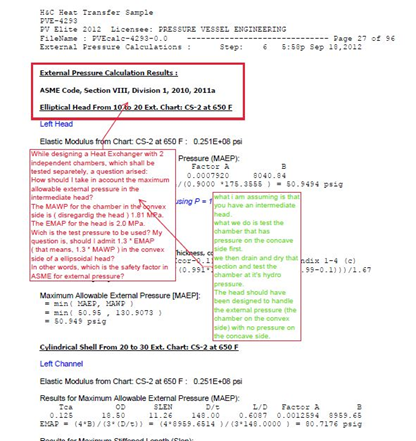
3) Issue: Sometimes, the external pressure conditions, such as atmospheric pressure variations or the pressure exerted by surrounding fluids, are inaccurately estimated.
Solution: Conduct a thorough analysis of the operating environment and consider factors such as altitude, temperature variations, and surrounding fluid properties to accurately determine the external pressure.
4) Issue: I was comparing the maximum allowable external pressures for a cylinder calculated with Italian VSR design code and with ASME ed. 01 add. 02.
The result was amazing: with a 2500 mm Do, and t=10, VSR allows about 0,8 MPa external pressure (The vessel is a jacketed one, with 0,7 MPa in the jacket and vacuum inside). Using ASME design formulae I need about t = 24 mm to resist the same pressure.
(values related to the same material, ASME SA240 TP 316L)
I was wondering: It’s my fault (I’m Italian, I’m not too familiar with ASME) or it’s ASME really this demanding against external pressure load?
Can someone check my comparison, perhaps using newer editions of ASME code?
(I’m pretty sure the VSR calculations are OK)
There are other references for external pressure vessel design?
Solution: A third parameter is missing: the length between lines of support. In ASME Code, the thickness required to support a given external pressure is a function of the geometric properties: nominal thickness, diameter, and distance between lines of support (rings, heads, etc.); it is also a function of the material properties and temperature.
Similarly, the maximum allowable external pressure will be a function of the same variables.
To rate the 2500 mm, Do x 10 mm thk cylinder for external pressure we need to know:
1- the length between lines of support,
2- material specification or properties,
3- temperature.
If you can provide the items 1 and 3, and an ASME listed material that is equivalent to your actual material we can determine the MAEP for the cylinder.
5) Issue: while calculating the thickness in case of external pressure we use graph from sec II-part D for calculating the allowable stress.
In any case suppose if we require to calculate the allowable pressure in case of compression how can we take the allowable stress value for carbon steel in case of compression?
Solution: As you mention “sec II-part D” it’s apparent you are referring to ASME Boiler and Pressure Vessel Code, and likely Section VIII application.
See VIII-I UG-23(b) for “the maximum allowable longitudinal compressive stress to be used in the design of …”. The method determines factor “A” and then you go into the charts of II-D for allowable stress.
6) Issue: Can anyone please tell me what is basically meant by external pressure when we talk about pressure vessel, is it atmospheric or what. please elaborate
Solution: No, it is not atmospheric pressure. When we talk about external pressure, we are usually implying a “negative internal” pressure, and is used to describe the effect of the vessel contents experiencing a very instantaneous change of state (liquid to gas). The rapid forming and evacuation of the gas from the vessel creates a vacuum-like effect making the vessel want to implode or collapse inwards. As it is impossible to create a true vacuum condition, we view the loadings as a positive external load inversely equal to the actual negative internal load. In this case, the external load would not be greater than atmospheric conditions. Neglecting sea level elevation, it is widely accepted as 15 psig or 103 kPag.
Reading back over that, I am not convinced my explanation is going to click. Anyone want to elaborate or correct that??
Granted, it can also be applied if the vessel is buried underground or water; it will be subject to an external pressure equal to the loading caused by the water (hydrostatic head) or soil.
7) Issue: Material properties, including yield strength, ultimate tensile strength, and modulus of elasticity, play a crucial role in withstanding external pressure. Ignoring these properties can lead to underestimation of the exchanger’s capacity to withstand pressure.
Solution: Ensure accurate data on material properties are used in the calculation. Conduct material testing if necessary and consult material specifications to obtain reliable data.
8) Issue: Inadequate reinforcement or structural design can result in the heat exchanger being unable to withstand external pressure, leading to deformation or failure.
Solution: Employ appropriate design practices, such as incorporating stiffening rings, ribs, or support structures, to reinforce the exchanger and distribute external pressure loads effectively.
9) Issue: Corrosion can weaken the material over time, reducing its ability to withstand external pressure. Failure to account for corrosion allowance in the design can compromise the exchanger’s long-term integrity.
Solution: Incorporate corrosion allowance into the design by adding extra thickness to the exchanger components. Consider the expected corrosion rate and service life when determining the corrosion allowance.
10) Issue: Failure to adhere to industry codes and standards, such as ASME BPVC or TEMA, can result in designs that do not meet safety and quality requirements.
Solution: Ensure compliance with relevant codes and standards by conducting the external pressure calculation according to specified methodologies and following recommended design practices.
11) Issue: Inadequate safety factors applied to the external pressure calculation can result in designs that lack sufficient margin of safety.
Solution: Apply appropriate safety factors to account for uncertainties in the design and operating conditions. Consider factors such as regulatory requirements, industry standards, and engineering judgment when determining safety factors.
Conclusion
In conclusion, accurate external pressure calculation is crucial for ensuring the structural integrity, safety, and reliability of heat exchangers. Issues such as inaccurate determination of external pressure conditions, lack of consideration for material properties, improper design or insufficient reinforcement, failure to include corrosion allowance, non-compliance with codes and standards, and insufficient safety factors can compromise the performance of the exchanger and pose risks to personnel and the environment.
To address these issues, engineers must conduct thorough analyses, consider material properties, employ appropriate design practices, incorporate corrosion allowance, comply with industry codes and standards, and apply sufficient safety factors. By doing so, they can ensure that heat exchangers are designed to withstand external pressure conditions effectively and operate safely in diverse environments.
Ultimately, prioritizing the accuracy and reliability of external pressure calculations is essential for enhancing the overall performance and longevity of heat exchangers, thereby supporting the efficient and safe operation of industrial processes.
Get detailed/ Get files/ Get customized/ Get trained by click link given here https://shreeaasaantech.com/contact-us/


